
Mono
Not a disease but the norm

Siberian Exile wrote this comment on my post “Jury” (emphasis mine):
I'm a butcher of foreign languages. As long as we can communicate effectively, I don't care about sounding like a native. I will never be a native! If people don't like the way I talk, that is their problem. Most of them only speak one language, so why should I care about their opinion? I can relate to the Japanese detective [referring to a Japanese cop show in which a Japanese native speaker with a non-Tokyo accent got hassled in Tokyo and snapped], I sometimes get told I have a strange accent. Then, I'm asked where I'm from. At the beginning I tried to fit in, now I just do my own thing.
The part I marked in bold ties into this part of my post:
Most [people I know] come from what I call mono backgrounds. I’ll explain that in another post.
The word mono came to mind as I was writing “Address” five days ago. Now I feel uncomfortable with it because it brings the kissing disease to mind.

I hadn’t made the connection at first because the disease is something I’ve only heard about on TV. I most strongly associate mono with monaural sound.
Here mono is short for monolingual and/or monocultural.
I don’t think of mono as necessarily ‘inferior’ or ‘bad’. I think mono might have been the default for most of human history.
I’ve heard the opposite claim - that multilingualism and multiculturalism was the premodern norm.
I can believe that would be the case for what is now the transitional area between northern India - home to most of the Indic languages descended from Sanskrit1 - and southern India - home to most of the Dravidian languages2. Indic and Dravidian have influenced each other from ancient times. The Dravidian language Telugu is full of Sanskrit loans that make it look Indic even though it isn’t. In Babel No More (2012), Michael Erard visited that transitional zone and met a family of polyglots:
[…E]ven the four-year-old grand-niece knew Hindi, English, and Telugu. Some languages were reserved for certain settings and people, and new languages seemed to follow jobs, not the other way around. The four-year-old’s mother, in her early thirties, said she speaks Telugu, Hindi, Marathi, Sanskrit, Tamil, Punjabi, Bengali, and English. How well? One presumes she could use them as she needed them. I was tempted to say that it’s hardly an environment where saying you have more languages means higher status, as it might in the West. Here, too, mentioning foreign languages is a power play; so is including Sanskrit as a language you speak, because Sanskrit is no longer a spoken language.
I am wary of polyglot claims - and am especially wary of claims about Sanskrit. Sanskrit is a super status symbol. When an Indian told me they had studied Sanskrit, I probed a bit. Whatever they had learned in school seemed to have long since evaporated, much like the Latin of the tiny minority of Americans who study it (2.3% of school students in 2007-2008).
I have no problem believing in the family’s abilities in less prestigious languages, though: e.g.,
Sri also uses Hindi with his two grown sons. With one of his daughters-in-law, he uses Tamil and English; he speaks in Kannada with the other. With his sisters he uses Tamil, though with one of his nieces, he speaks in Telugu. He speaks in Kannada with Kala’s sisters. Though he speaks Hindi, Kannada, Tamil, Telugu, and English, he reads and writes only in Hindi and English.
If the British had never come to India - if Hindi hadn’t spread southward - Sri would probably still be a polyglot. And he’d probably still be named “Sri” - a Sanskrit name.
The rest of the world wasn’t like that part of India, though. Even parts of India aren’t like that. A Brahmin I knew grew up with Sanskrit, Hindi, and English. The end. In an India without British rule, he’d only know Sanskrit and Hindi - and the regular people around would just know Hindi.
I am descended from regular people in Japan. Not the miniscule elite who also knew 古文 kobun ‘old writing’ (Classical Japanese) and 漢文 kanbun ‘Chinese writing’ (the Japanese flavor of Classical Chinese). Even in the early twentieth century, Gen. Nogi, a commander in Japan’s wars against China and Russia, could write 漢詩 kanshi - kanbun poetry. Here’s the first line of a kanshi he wrote after the Russo-Japanese War with the words numbered (you’ll see why soon):
1 皇 kō ‘emperor’
2 師 shi ‘army’ (normally ‘master’, but not here)
3 百 hyaku ‘hundred’
4 萬 man ‘ten thousand’
5 征 sei ‘to go on an expedition’
6 強 kyō ‘mighty’
7 虜 ro ‘northern barbarian’ (normally ‘prisoner’, but not here)
The line consists of Chinese words written with Chinese grammar, but the words are pronounced in ‘Sino-Japanese’ (Japanized Chinese pronunciation) in a slightly different order with the verb (character 5) moved to the end as in Japanese grammar plus two unwritten Japanese bits I’ve indicated in all caps: WO and SHI.
1-2-3-4-6-7-[WO]-5-[SHI]
皇師百萬強虜征
kō shi hyaku man kyō ro WO sei SHI
‘The (Japanese) emperor’s army - a million (100 x 10,000) [men]3 - went on an expedition against the mighty northern barbarians (i.e., Russians), and …
WO indicates that what precedes it is the object of the verb.
SHI ‘does, and …’ is needed to make 征 sei a verb because bare roots cannot function as verbs in Japanese. The ‘and …’ in my translation indicates that SHI is not a verb that can end a sentence; it implies there is more (and there are three more lines in the poem that I didn’t translate).
That’s just a bit of the mental gymnastics involved in writing kanshi. I find it much easier to read kanshi as Chinese without converting it into Japanese by moving words around and adding words that aren’t there.
My grandfather must have had to read kanshi to get into university in Japan. Over half a century later, I studied kanshi at university in Japan. But it is likely that we two are outliers, and that nobody else in our family prior to the last century had to study Chinese.4
In previous centuries, my ancestors were village peasants with zero contact with foreign languages - or even dialects of Japanese other than their own. The elite used classical languages (older literary forms of Japanese and Chinese) because they were transregional like Latin in Europe and could be understood across Japan - unlike the speech of farmers.
In Japanese Assimilation Policies in Colonial Korea (2009), Mark E. Caprio wrote that at the dawn of modern Japan,
Japanese “dialects” and appearance seemed so different that, on one occasion, a Japanese girl from the countryside mistook the language she heard Japanese speaking upon her arrival in Tokyo as French.
Caprio quoted what one resident of what would become Toyama Prefecture in central Japan said about soldiers from Satsuma in southern Japan about 500 miles (800 km) away c. 1870:
Their words were gibberish and I could not understand a single thing. It was truly like encountering Westerners.
A century and a half later, the Japanese public school system has spread Tokyo Japanese across both the Japanese and Ryukyuan archipelagos, and everyone can speak it, albeit with different pitches I can’t hear. The apparent homogeneity of modern Japan is a recent imposition.
The Native Hawaiians 3,800 miles (6,200 km) away from Japan were also mono prior to modern times.
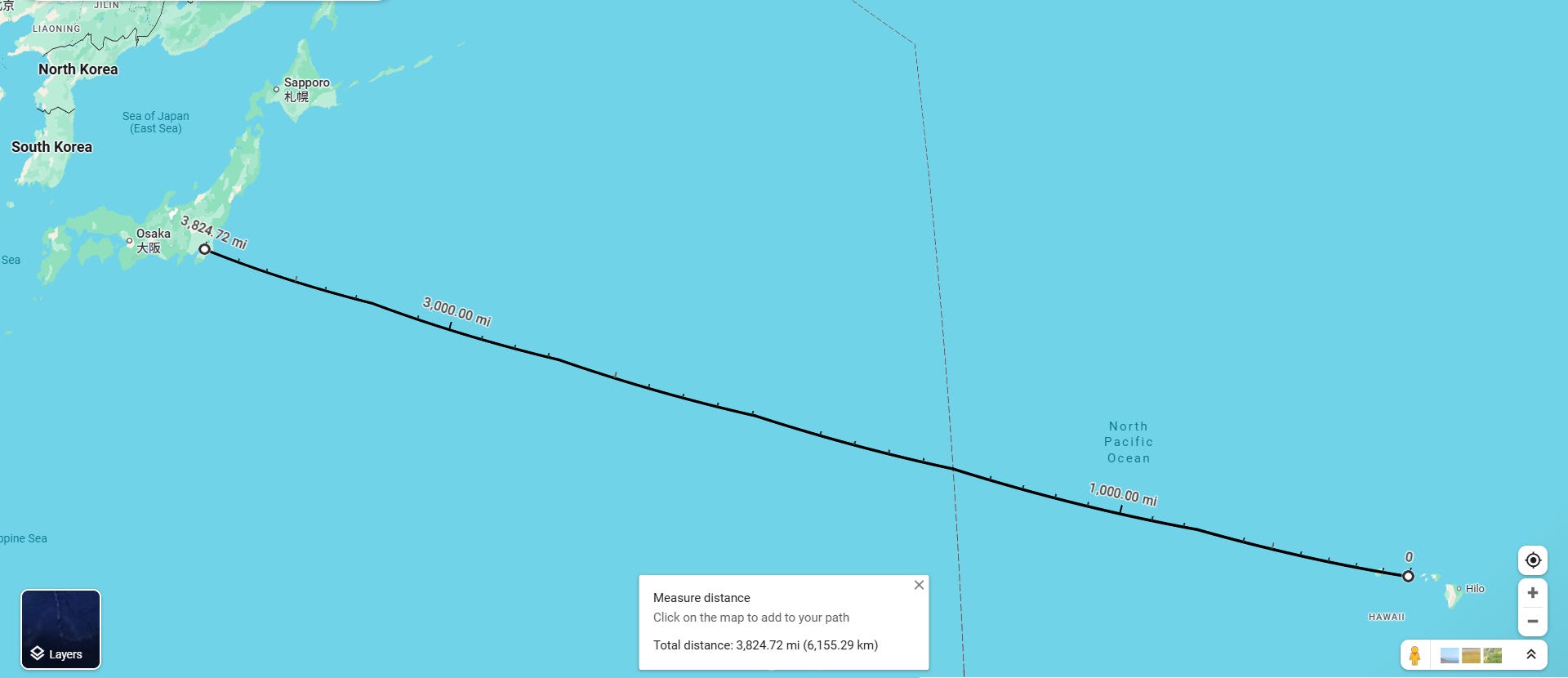
Unlike my Japanese peasant ancestors who might have had some vague notions of foreigners - just names - the premodern Native Hawaiians had not seen anyone else for ages until Captain Cook showed up in 1778. The Hawaiian archipelago was the universe of its inhabitants, and its islands might as well have been different planets. The islands were not all unified under a single ruler until 1810. King Kamehameha and his successors ruled all of those islands for less than a century. Their dynasty was overthrown in 1893.
By then, Hawaii had gone from mono to poly, and Native Hawaiians themselves had lost their mono status. They had one foot in the White world due to their conversion to Christianity and in many cases their marriages with Europeans. And around them were increasingly diverse laborers from Asia, Europe, and even Puerto Rico, bringing their many languages and creating the Pidgin language to enable them to all communicate among one another.
It is perhaps amazing that the random people zone of Hawaii functions because there has traditionally been nothing like it. Diversity is not instantly fatal. Man is an elastic, adaptable species.
However, stretching has its limits. While Hawaii as a whole is poly, almost all people here are either mono or bi (their native language/culture plus English and/or Pidgin to deal with everyone else). There is almost certainly no one who can
read both a pre-1949 Hawaiian-language newspaper and Chinese poetry
talk to fast food employees in their native Philippine language
be simultaneously at home in
a mosque
a Korean Buddhist temple
a Samoan-language Latter-Day Saint ward
I will say this for the nth time: Nobody understands Hawaii.
So diversity management here is just pandering to the lowest common denominator - or worse. Our mono rulers don’t understand what their equally mono constituents want - or care. Why bother, if you’ll win elections anyway? The One Party rules forever.
The exceptions are the Romani (Gypsy) languages of Europe and Domari of the Middle East and northern Africa.
Brahui is the one Dravidian language spoken outside South India - in Pakistan, of all places. Why it’s there is a mystery.
I thought a million was an exaggeration, but if I understand Wikipedia correctly, a total of 1.2 million Japanese men were deployed over the course of the Russo-Japanese War with a peak of 650,000 men at some point.
All my relatives who were educated in Japan during the last century probably did have to endure at least a smattering of Classical Chinese in school.
I'm at the point where I can communicate with no issues whatsoever with people I've spoken to before a few times. People who talk to the same people about the same topics will seriously overestimate how fluent or "native" they are. The other day I had to take my daughter to the dentist and it turned out that communicating with a grumpy women behind a face mask plus another mask over her mouth over a bunch of screaming kids about dental related topics is a level of fluency I don't have yet. Also talking to the representative of a company that specialises in finding water sources and digging wells is another level of fluency of I don't have yet. On both occasions I eventually was able to sort out what needed sorting out but not as fast and smoothly as a native speaker by any means. But that is what real fluency actually is, being able to communicate under stress and in chaotic situations about any topic and just knowing what words mean intuitively.