
Address
A word that still haunts me in two languages forty years later

My last post was about the origin and extent of my obsession with the Japanese language.
At school I got the reputation of being the ‘Japanese’ guy - and I don’t mean simply being of Japanese ancestry, which was common and hence unremarkable. I pushed anime in the mid-eighties before it was cool. Nobody listened to me. I was an otaku, though no one in Hawaii knew that word yet - not even me.1
I read Japanese books in study hall, in the car, on vacation - at every spare moment. Until I got a VCR for Christmas in 1985, reading was the only way I could keep up with the latest TV shows and movies in Japan. The original local Japanese language TV station had turned (ugh) American2, and its replacement had stopped importing kids’ shows.
I spent a summer vacation reviewing Japanese using this book:
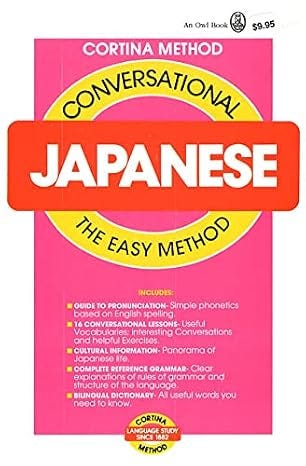
I used it so much that the spine broke and the back cover came off. I do not recommend it. It was old even then (my copy is copyrighted 1963 despite the newer-looking cover) and boring. But it was what I could find in a Honolulu bookstore. A physical one. No Amazon back then. When Borders opened here, it was a revelation. But I digress …
The summer after the Textbook Summer was the Suncoming Summer. My first visit to Japan.
I can still remember some of the music I heard on the JAL plane.
Like ELO’s “Calling America” when I was leaving America3.
Or was that on my back to America? I didn’t keep a diary back then.
I didn’t listen to Japanese pop music then.4 That should have been a sign that I wasn’t as heliophilic as I thought I was. I didn’t see any contradiction between listening to ELO and reading ジ・アニメ特別編集 機動戦士Zガンダム PART 3 (The Anime Special Edition: Mobile Suit Zeta Gundam Part 3).
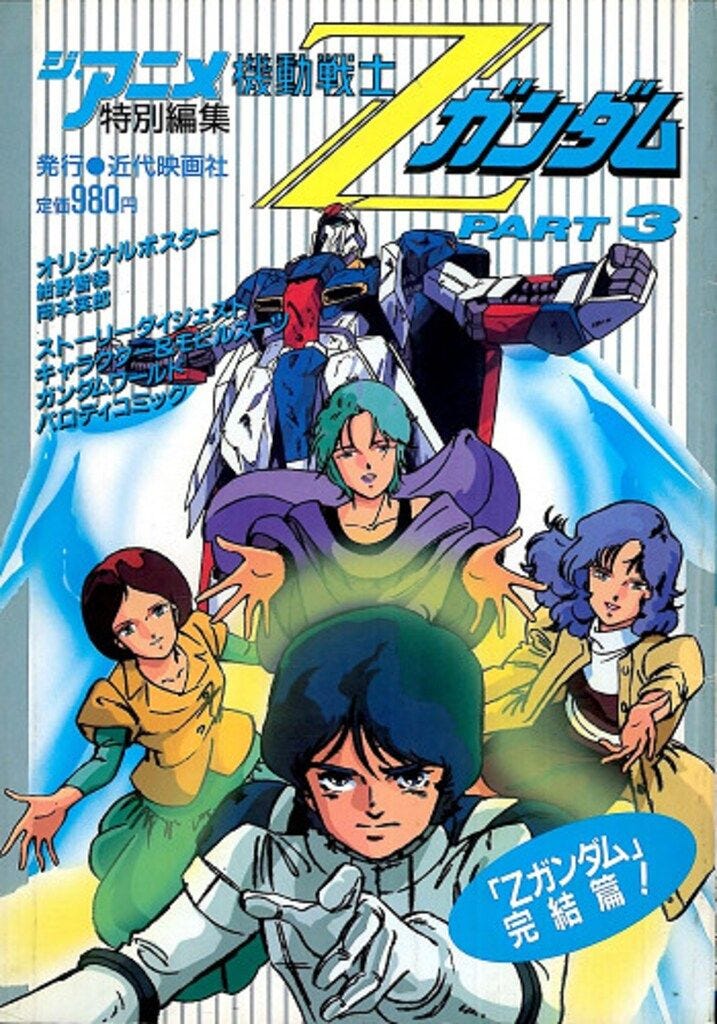
And I could argue there was no contradiction. The Japanese do listen to 洋楽 yōgaku ‘ocean music’ (music from across the sea: i.e., Western music) as well as J-pop. But looking back, it was funny that I believed Japan was soooo ‘superior’ in every way except in pop music.
I wanted to be ‘superior’. To be Solar. To ‘reclaim my birthright’. Barf. How moronic that sounds now.
It wouldn’t sound quite so stupid if I had succeeded.
In theory, a member of the Japanese diaspora of solely Japanese ancestry could ‘reintegrate’ completely with ‘their’ people in Sunland, get Solar citizenship, and be 100.0% indistinguishable from the Really Solar - become Really Solar except for their memories of their shameful past in the USSA or Brazil or wherever5.
In reality … ask the Dekasegi6:
In the 1990s, the migration flow of Brazilians to Japan grew even more, thanks to the 1990 reform of Japan’s Immigration Control Law. With this law, Japan allowed Japanese descendants born abroad, up to the third generation (children and grandchildren of Japanese), to work in Japan with long-term residence visas. This was a way for the Japanese government to address the labor shortage in Japan without disrupting the country’s ethnic homogeneity, with a clear preference given to Latin Americans, mostly Brazilians, of Japanese descent. At that time, Japan was receiving a large number of illegal immigrants from Pakistan, Bangladesh, China, and Thailand. The legislation of 1990 was intended to select immigrants who entered Japan, giving a clear preference for Japanese descendants from South America, especially Brazil. Consequently, between 1990 and 2000, the number of Brazilians in Japan quintupled, reaching 250,000 people.
[…]
Because of their Japanese ancestry, the Japanese government presumed that Brazilians would be more easily integrated into Japanese society. In fact, this easy integration did not happen, since Japanese Brazilians and their children born in Japan are treated as foreigners by native Japanese.
If Yoko Ono, born and raised in Japan and still a Japanese citizen de jure, is no longer de facto Solar after ‘too many’7 years abroad, then what hope would the Dekasegi have? Or me?
This apparent contradiction between being and seeming causes conflicts of adaptation for the migrants and their acceptance by the natives.
Nobody told me about that contradiction. I had to experience it.
I didn’t expect it. When I landed in Tokyo, it felt familiar, not exotic. I stayed in the Keiō Plaza Hotel which I had seen countless times on TV.
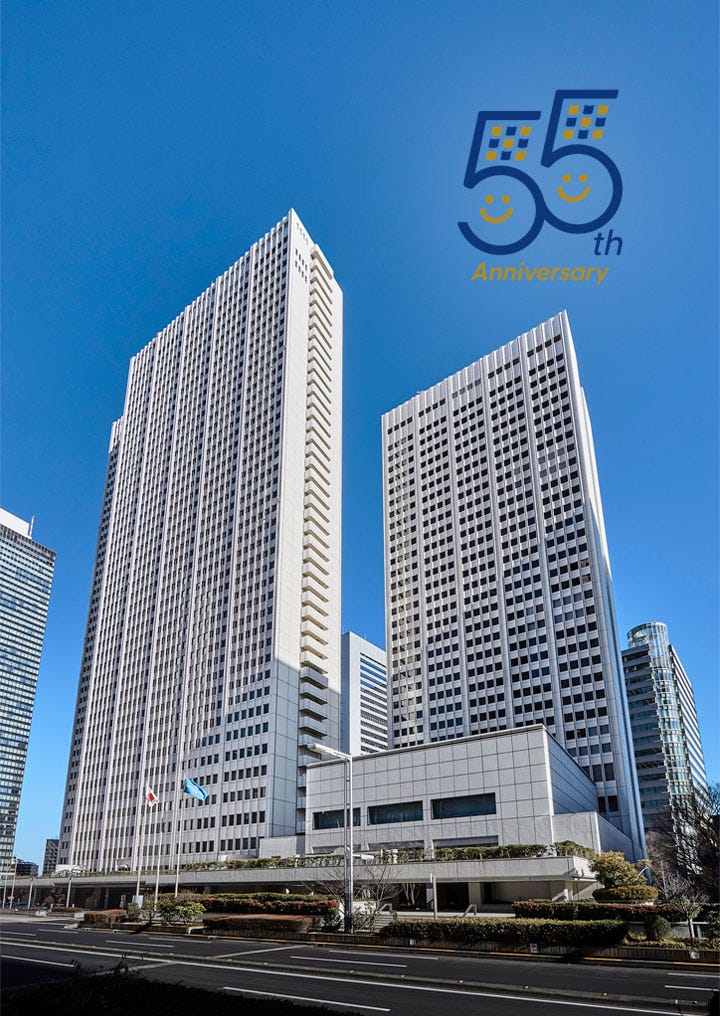
I knew Tokyo’s TV channels from reading about them. I knew what shows to watch and when to watch them.
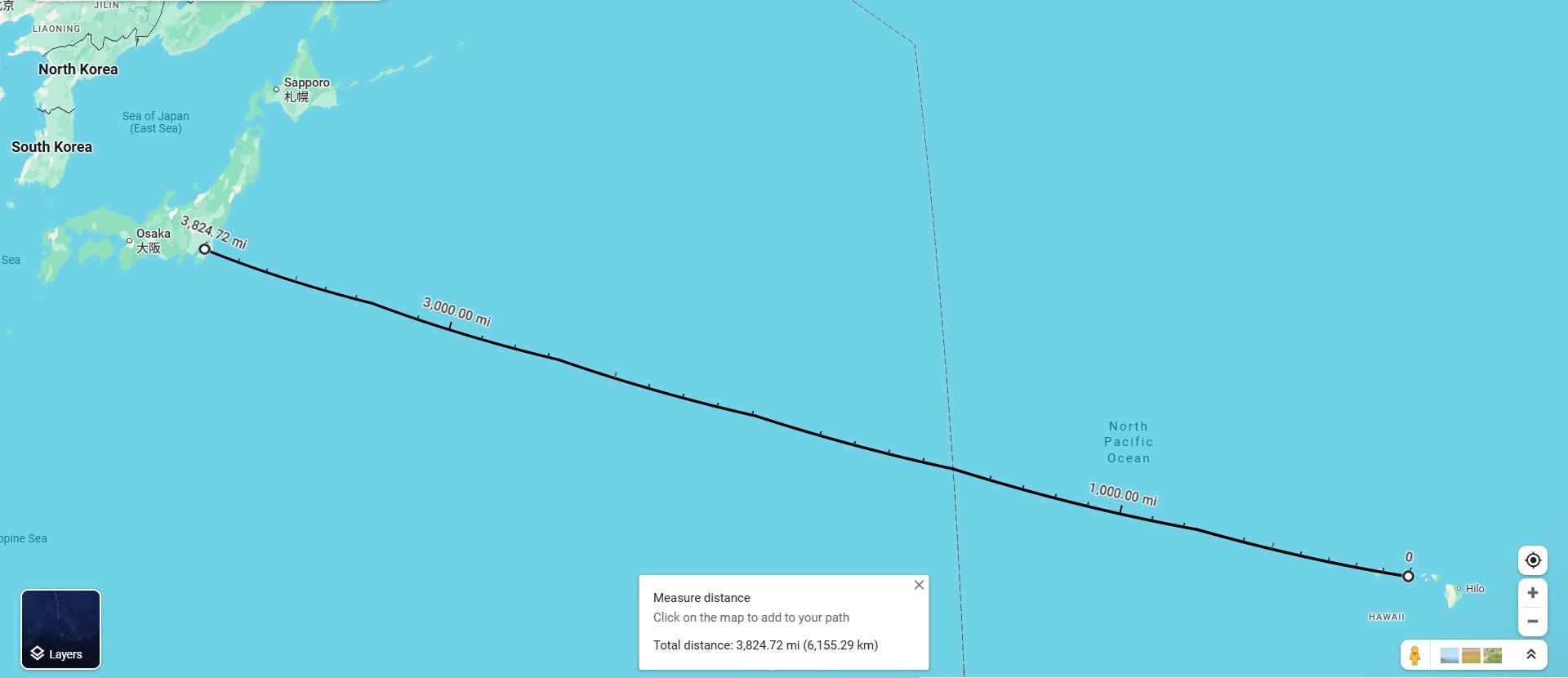
Obviously I hadn’t flown 3,800 miles (6,200 km) just to watch TV.
I went shopping. On my first night I found a small bookstore near my hotel. Even it stocked books for otaku!
I wanted more. I went to the Shinjuku flagship store of the Kinokuniya bookstore chain.
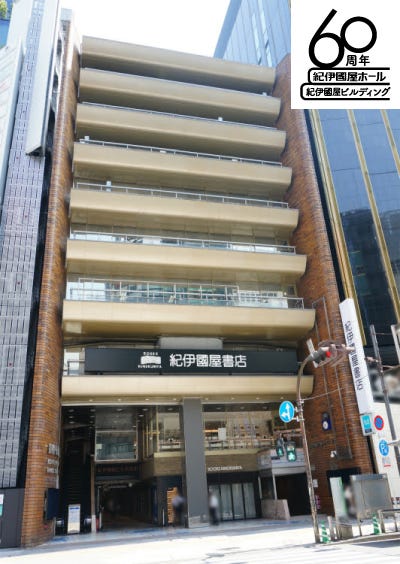
All those floors have books. I could have easily spent all my cash there, but I had to be selective.
To this day I remember an issue of the anime fan magazine Out that I flipped through but decided not to buy. It had a parody article with a fictitious fusion of マジンガーZ Mazinger Z (1972-1974)8 and 重戦機エルガイム Heavy Metal L.Gaim (1984-1985) as 重合金マジンガイム Heavy Alloy Mazingaim.9
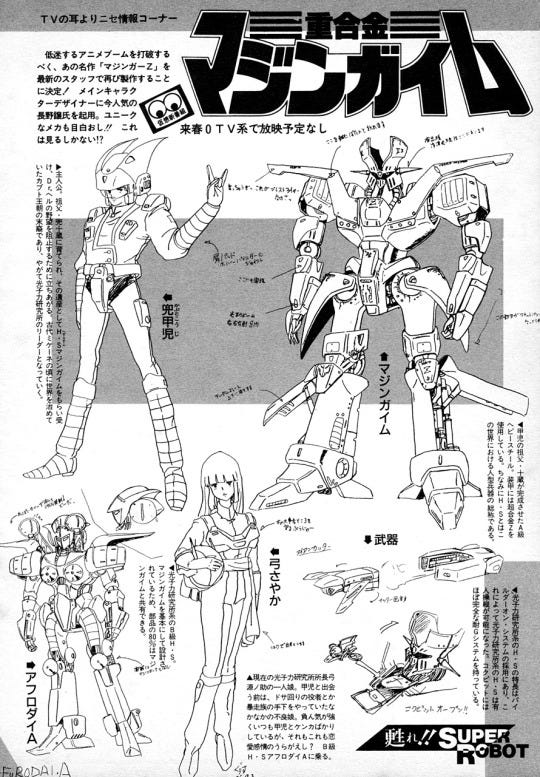
It was already expensive to keep up with real anime, so I had to say no to that ‘coverage’ of fake anime.
I could not say no to a whole store for anime fans: Animepolis Pero.
I could not find it!
I had the address:
新宿区新宿三丁目1番26号
Shinjuku Ward, District 3, Block 1, Building 26
I was in the general area. The trouble is that the Japanese address system is a nightmare10:
[… I]f you step onto the streets of Tokyo, you will notice something incredibly bizarre: almost none of the roads have names. Aside from a few massive avenues, the entire maze of streets in Japan is completely nameless. To a Westerner, this looks like a logistical nightmare. How can millions of people navigate a world-class megacity when the streets don’t even have names?
The secret lies in a completely different philosophical framework for thinking about space. Instead of naming the “lines” (streets), Japan names the “spaces” (blocks). The Japanese address system divides a city into distinct geometric zones. It starts from the large prefecture, moves to the city or ward, and then down to the neighborhood name. Inside that specific neighborhood, everything is managed by three sets of numbers: the district (Chome), the block (Ban), and the building (Go). When you look for an address, you aren’t looking for a spot along a road; you are playing a geographical game of hot-and-cold, hunting for a specific puzzle piece inside a shrinking grid!
Logical, right? I think so. I actually like the Japanese system … to a point. So what’s the problem?
Furthermore, there is a fascinating historical paradox to the final building numbers. In the United States, houses are numbered sequentially (101, 103, 105). In Japan, however, buildings inside a specific block were historically numbered based on the order of when they were built. This means House No. 1 could be sitting right next to House No. 15 if it was constructed decades later! While this system causes massive confusion for tourists and foreign delivery drivers, it perfectly reflects Japan’s traditional communal mindset—valuing bounded neighborhoods over endless, linear open roads. Just make sure your smartphone battery is fully charged before you start exploring!
Too bad smartphones didn’t exist then.
So I went to a pay phone and called the store for directions. Making phone calls in English terrifies me. I was petrified to make a phone call in Japanese. The directions I got made no sense to me. I broke down and asked (in Japanese) if there was someone who could speak English. Nope. I hung up.
I think I then went to a nearby kōban (police box) and asked an officer if he could tell me where the store was.11 Nope. He had no idea what I was talking about.
Only later did I realize that I might have confused him by calling the store Anime Porisupero. I had the idea stuck in my head that the store was named after Prospero from The Tempest, which I had recently studied in my English class. But the actual name of the store in Japanese was Animeporisu Pero: Animepolis Pero. I had seen the name of the store written “アニメポリスペロ” without a dot indicating the break between the two words in its name.12 I did not know the store was named after Pero, the main character of the anime movie 長靴をはいた猫13 Puss in Boots (1969) which I have never seen.14
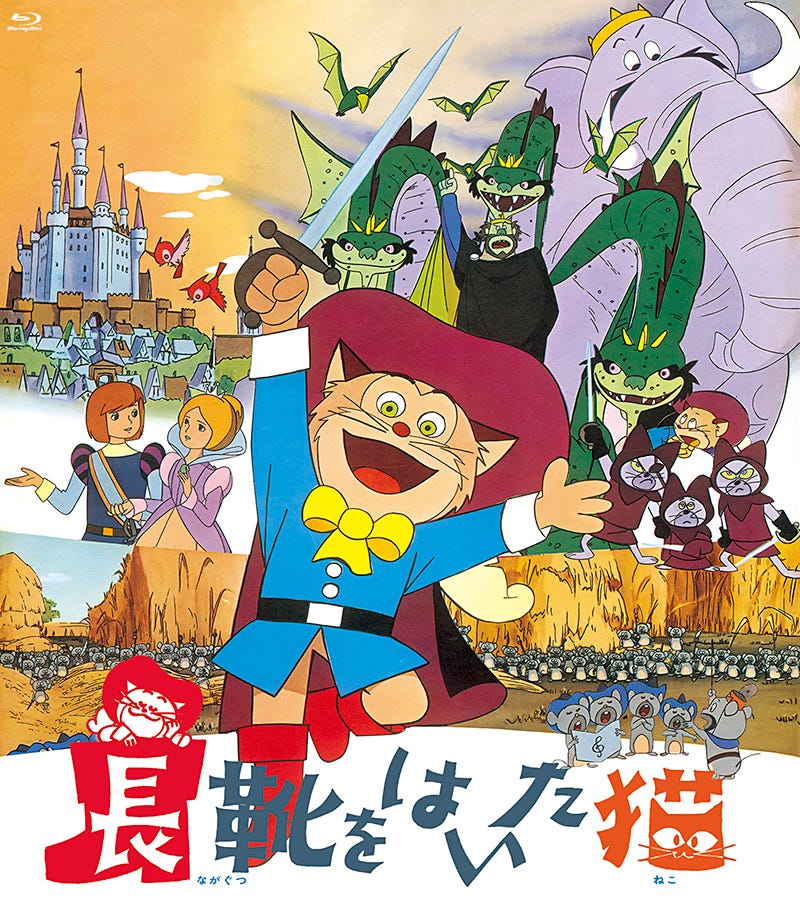
Maybe the cop wouldn’t have recognized the name even if I had pronounced it properly.
Whatever. The bottom line was that I had spent over a decade studying Japanese - and when I was put to the test, I failed.
I feel bad for the people I talked to, wondering who this weirdo was. In those days almost no foreigners would be going to an otaku store.15
The sign for the store is on the right under a poster for The Bone Collector (1999) in this picture.
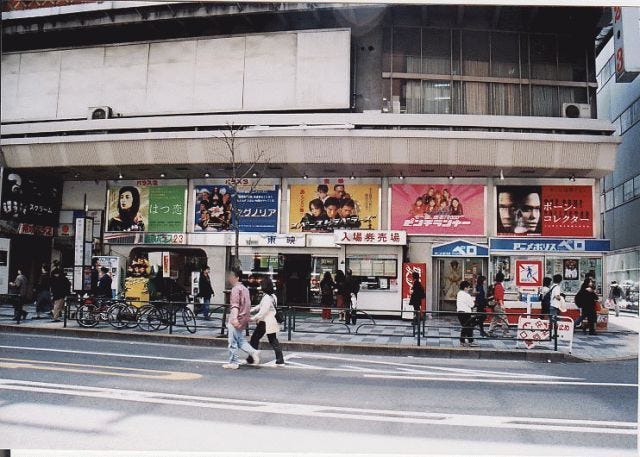
Animepolis Pero was founded by Toei, the company that produced the shows that formed my childhood - and Puss in Boots, the source of its name. The store was in the basement of a Toei theater; its ground-level entrance was next to a ticket booth (with 入場券売場 ‘enter-place-ticket-sell-place’ in red above it). I think I eventually did find the store during a later trip to Japan. I definitely went to a basement otaku store. If that store wasn’t Pero, I must have lucked out to stumble upon another one in Tokyo.
After a few days in Tokyo, I spent the rest of the trip visiting other parts of Japan. Such as the area where some of my ancestors came from - and where some of my distant relatives still lived.
A few of those relatives had just returned from living in the Netherlands for several years. I assume the father had been sent there on business and brought his family with him. I talked to the son who … tolerated me. Barely. In hindsight, I’m surprised he asked me for my jūsho.
My what?
“Address,” he said in perfect English. Not アドレス adoresu with a Japanese accent. (Adoresu is also a Japanese word.) He must have learned English at school in the Netherlands. Later I would learn about the great English skills of the Dutch. Who weren’t on my radar yet. My worldview was so narrow. I didn’t even ask the son about the Netherlands. All I cared about was Japan.
And yet I didn’t know the Japanese word for ‘address’! Even though it would have been transparent if I had known the spelling16: 住 jū means ‘to live’ and 所 sho means ‘place’. Place where one lives. Somehow I had never come across it in all my years of watching TV and reading books. It wasn’t even in the Cortina textbook! (I checked tonight.)
To this day - after over half a century of exposure to Japanese - there are random holes in my Japanese vocabulary.
Which isn’t that surprising given the nature of that exposure. Suppose someone learned English from watching Star Trek and Star Wars and reading tie-in material. It’s not as if Captain Kirk or Luke Skywalker would ever say the word address.
I would hope that someone that much into American sci-fi would not decide to move to the USSA because of their favorite franchises. The USSA is not the Federation or “a galaxy far, far away”. It is a real place with real problems.
Just like Japan.
A place (所 sho) where people live (住 jū). 住所 jūsho. Address.
Despite my problems with addresses - the location of Animepolis Pero and the word for ‘address’ - I still wanted an address in Japan. I thought I just needed to go home and try harder. And I did. Spoiler: I failed.
I’m ashamed. This isn’t one of those stories where the foreigner goes to Japan for the first time, LURVES it, TOTALLY gets into the language and culture, and becomes Nearly Solar. This is a story about poor ROI: return on investment.
My life is a waste.
I want it to be a warning.
I didn’t know the word otaku until some time after this 1989 case. I have never liked the word. I use it in reference to myself here because I regard it as derogatory. An English speaker calling themselves an otaku to me is like a Japanese person calling themselves a rūzā ‘loser’ (which is not a word in Japanese … yet).
That station would later become a Fox and an NBC affiliate without any trace of its Japanese origins.
I’d normally write “Hawaii” rather than “America”, but the song wouldn’t really fit if I had written “Hawaii”.
Lest you get the impression I’m against all Japanese music, I love the music from the Japanese shows and movies I used to watch before screens put me to sleep. I bought 45 RPM records of TV show themes during my first trip to Japan. And I have gone through phases of listening to J-pop which I still do enjoy. Nonetheless, my number one musician is Jeff Lynne.
To my surprise, the #3 country for the Japanese diaspora is … Peru.
Peru was the first Latin American country to establish diplomatic relations with Japan, in June 1873. Peru was also the first Latin American country to accept Japanese immigration.
I knew there were Japanese in Peru (thanks to Alberto Fujimori) but not that Peruvian Japanese outnumber Canadian Japanese (Canada is #4). I thought Canada was #3.
From 出 de- ‘to go out’ and 稼ぎ kasegi ‘earnings’: i.e., one who earns money after having gone out from their home community.
Single quotation marks indicating ‘supposedly’ rather than double quotation marks indicating a direct quotation, because I’ve never heard anyone say Yoko Ono spent “too many” years abroad. But I’m certain that if Ono had not spent her almost all of her adult life outside Japan, she would still be Really Solar.
I’m half-surprised I hadn’t written about Mazinger Z yet. It wasn’t the first giant robot anime, but it started a boom for the genre in the seventies. I may write about it on Substack when it turns fifty-five next year.
重合金 Heavy Alloy is a blend of 重戦機 Heavy Metal and 超合金Z ‘Super Alloy Z’, the metal of Mazinger Z’s armor.
The Japanese exported their addressing system to Korea during the colonial period. South Korea finally got rid of it in 2011, This article gives me the impression North Korea might retain it. I assume Taiwan had it under Japanese rule but lost it when the Republic of China took it. When I visited Taiwan, I was relieved to see street names. I don’t know if Japan exported the system to their colony in Micronesia.
I am not sure this is quite what happened because I have no memory of walking up to a kōban and talking to a man in uniform. But I am certain I asked someone about “Anime Porisupero” (sic; see my explanation of this misnomer later in my article) and got a ‘what are you talking about’ response. I can’t imagine I talked to some random person on the street. I wasn’t so naive to believe everyone knew where an otaku store was. And an Animepolis Pero employee on the phone would have known the name of their own store even if I distorted it slightly. A kōban cop seems to be the only rational possibility given that
koban are used by the public to ask directions [and] find street addresses (the police have excellent local maps)
i.e., maps with the unpredictable numbers for blocks. Maybe I blanked out details because I was (and still am) so embarrassed.
Japanese is normally written without spaces between words, but dots are used to indicate breaks between foreign words including names. It is telling that Yoko Ono’s name is now written with a dot (オノ・ヨーコ) just like her famous husband (ジョン・レノン Jon Renon).
The Japanese title is literally The Cat Who Wore Long Shoes.
I don’t feel too bad about not having seen the movie. How many anime fans outside Japan know about it today?
When I went to an otaku store on my last trip to Japan a few years ago, there were English signs, employees who could speak foreign languages, and lots of foreign customers. A far cry from when I felt I was the only fan outside Japan.
But I didn’t know the spelling of 住所 jūsho ‘live-place’ = ‘address’, and there are many homophonous roots in Japanese that are spelled differently: e.g., jū can also be 十 ‘ten’ and sho can also be 初 ‘first’. Fortunately, there happens to be only one Japanese word pronounced jūsho, but there are many homophonous root combinations: e.g., my pocket dictionary lists four different jūshin with three different jū which aren’t 住 jū ‘to live’:
銃身 jū ‘gun’ + shin ‘body’ = ‘gun barrel’
獣心 jū ‘beast’ + shin ‘heart’ = ‘brutal heart’
重心 jū ‘heavy’ + shin ‘heart’ = ‘center of gravity’ (in Japanese ‘gravity’ is called 重力 jūryoku ‘heavy-strength’)
重臣 jū ‘heavy’ + shin ‘minister’ = ‘senior statesman’ (cf. how Sanskrit guru- ‘heavy’ also means ‘teacher’; in both cases weight is associated with greater authority)
You are way way too hard on yourself. Just disastrously so. I think you over corrected my man :)
Is Yoko Ono still native-level in Japanese after all these years? Does her son speak any?