
Tofu
Why I'm in Hawaii

My last post was titled “Suncoming”, a rendering of 来日 rainichi, a Japanese word referring to the arrival of a non-Japanese person in Japan: i.e., Sunland. It was supposed to be about my Suncoming forty years ago this month but ended up about the word and two famous people on the border between Japanese and non-Japanese:
Yoko Ono, ethnically Japanese and still a Japanese citizen but no longer considered Japanese ‘enough’ to
have her name spelled like a Japanese name
or to have her return to Japan as an adult1 referred to as 帰国 kikoku ‘return to (one’s home) country’
SoftBank founder Son Masayoshi, Japanese in every way except for his Korean ancestry
had his return to Japan referred to as 帰国 kikoku ‘return to (one’s home) country’ in the Japanese Wikipedia
but in the Japanese Wikipedia was not described as Japanese in the first paragraph which emphasizes his Korean background
I’ve spent most of my life facing that border. I’ve never had the right to refer to me going to Japan as 帰国 kikoku. Which is why I called my first visit 来日 rainichi - suncoming. I am not Really-Solar …
… like all my great-grandparents were.
I don’t know most of their stories and will never know them. They are long gone, and their lore went with them - with one exception.
I hope I’m getting this right:
One of my great-grandfathers was the nth child in a big family of farmers, back when Japanese were fertile. When boys had names like 十郎 Jūrō ‘ten young man’: i.e., ‘tenth son’2. Who would have guessed back then that Japan would have a fertility rate of 1.14?
The oldest son was going to inherit the family farm. So my great-grandfather decided to take his chances and do a 渡布 tofu.
Not eat 豆腐 tōfu, literally ‘bean rot’.
The two words are spelled and pronounced differently in Japanese.
豆 tō ‘bean’ has a long vowel (indicated by the macron ˉ over o), whereas 渡 to ‘to cross water’ has a short vowel.
腐 fu ‘rot’ (nowadays also a prefix indicating interest in yaoi) and 布 fu (short for 布哇 Hawai ‘Hawaii’) are homophones but look nothing alike in writing.
Hawaii is one of those places notable enough in Japanese to have its own one-character abbreviation 布 fu, though these days that has been replaced by the more transparent one-katakana abbreviation ハ ha.3
So what was once called 渡布 tofu is now called 渡ハ toha. Both mean ‘crossing (the sea to go to) Hawaii’.
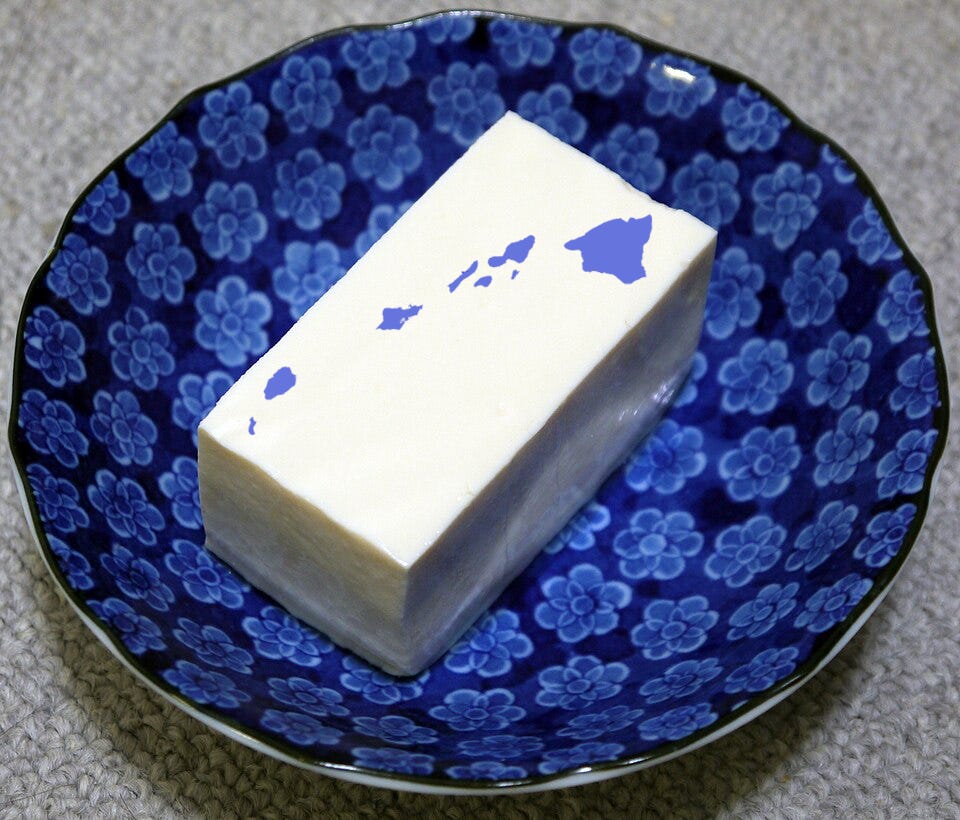

.JPG)
I’m going with tofu because that was the term current in my great-grandfather’s day.
In Hawaii, he married (a picture bride?) and had a large family - and founded a successful business. The point of his tofu was to make money - not find freedom or some other cliché reason for Coming to America. He brought his money and family back to Japan, where they could live comfortably. At least in theory.
In reality, his children had difficulties. They were ethnically Japanese and raised by Really-Solar parents in the Japanese way. They went to Japanese-language schools after regular English school like 98% of the Japanese children in Hawaii at the time. Before the war, the Japanese in Hawaii insisted that their children get a Japanese education. I don’t know of any other ethnic group in the United States with such a hardcore devotion to the ways of the ‘old country’. Although I consider America to be where identity dies, the Japanese in Hawaii managed to maintain their identity on a mass scale …
… but not enough for my grandfather and his siblings to 100.0% pass as Solar.
Even decades later in modern Japan, 帰国子女 kikoku shijo ‘sons and daughters (who) returned (to their home) country’ were viewed
in the 1970s as problem children who needed assistance in readjusting to Japanese society; they were thought to be too Westernised and individualistic.
It wasn’t fun to be Almost-Solar.
Nonetheless my grandfather studied hard to get into a famous university despite having spent most of his life in Hawaii. Only 3% of Japanese could get into a university in the 1930s. I assume the entrance exams were even harder than they are now.
And that Classical Japanese and Classical Chinese were even more prominent exam subjects than they are now. Japanese language education in Hawaii would have enabled him to transition toward a native-level command of modern Japanese, but as far as I know, Japanese schools in Hawaii never tried to teach Classical Japanese or Classical Chinese, the other two musts for the Japanese elite. The Japanese schools here aimed to make kids here emulate the average Japanese - an already difficult enough task.
I just realized I sort of did what my grandfather did - study Classical Japanese and Classical Chinese in a hurry. I wasn’t under pressure to get into a university with my knowledge of either, though. Nor did I have to study higher math or science, neither of which is on the American SAT.
When my host father in Japan spoke of the SAT as this scary thing, I was amused. It’s a joke compared to a Japanese university entrance exam.
I don’t know how my grandfather passed, but he did.
He didn’t stay at his university long, though. He could see signs of what was coming:
From 1931 to 1937, China and Japan engaged in skirmishes, including in Shanghai and in Northern China.
He didn’t want to die. Wikipedia says 455,000 to 700,000 Japanese military personnel died during the war with China. Died for nothing. Japan lost all its foreign territories, including those it had before that war - Taiwan (won during a previous war with China), Korea, and Micronesia.
So my grandfather dropped out of the university that he had worked so hard to enter. He returned alone to Hawaii, determined like his father to make money - enough to pay for most of his siblings to join him one by one.4
In Hawaii, he met my grandmother whose roots were in a completely different part of Japan. They would never have met in Japan.
I would never have existed in Japan.
I am the product of two tofu with imperial ambition in between.
If my great-grandfather had not made tofu, he would not have married my great-grandmother in Hawaii and had my grandfather, an American citizen at birth.
If Japan had not wanted China, my grandfather would have stayed at his university.
If he had not made tofu like his father before him, he would not have married his wife in Hawaii - again like his father before him.
But unlike his father before him, he was an American citizen and a fluent speaker of English. That made the second tofu much easier than the first.
There would not be another tofu after he paid for most of his siblings to come here.
I think he went the other way only twice. Both after the war. And before I was born.
He was gone by the time I went.
I never got to ask him about his time in Japan. I didn’t even know his story until recently. He wasn’t the talkative sort. Unlike me, telling his story out here in public.
The story of how he refused to die for nothing. Of how he worked hard - first to beat the odds for himself and join the 3%5 - and then to reunite his family in Hawaii and get them out of an empire that would become a madhouse.
The story of a man.
The Japanese Wikipedia used the term 帰国 kikoku ‘return to (one’s home) country’ for a young Yoko Ono returning to Japan from abroad. The implication was that she was still Japanese as a child.
Rotate the Chinese character 十 ‘ten’ ninety degrees and you get the Roman numeral X … which coincidentally resembles the Suzhou numeral 〤 ‘4’ and the archaic Chinese character 㐅 ‘five’ (now written 五; you can see still see the cross in the middle of that modern form).
Why wasn’t ‘Hawaii’ abbreviated in Japanese as the obvious Ha from the start? 田野村忠温 Tanomura Tadaharu solved that mystery in a 2025 article:
Hawaii used to be known as Owhyhee in English.
That name was borrowed into nineteenth-century Cantonese as 阿哇希 Owaahi (which would now be pronounced Owaahei if it weren’t extinct; the modern Cantonese name for Hawaii is 夏威夷 Haawaiyi)
The Japanese borrowed the last two characters 哇希 as a spelling for Hawai ‘Hawaii’.
The second character 希, normally read ki, was miswritten as 布 fu.
哇布 looked strange as a spelling of Hawai ‘Hawaii’ because 哇 was read as wa in 爪哇 Jawa ‘Java’ and as ai in 咬哇 kōai ‘rustic and vulgar noise’, but Hawai didn’t start with Wa- or Ai-. It did, of course, end in -ai.
So 哇布 was ‘corrected’ by moving 哇 wa/ai to the end, resulting in 布哇 which looked like a better match for its reading Hawai.
However, it was still an imperfact match because 布 fu, the distortion of 希 ki, was never ‘corrected’ to something that sounded like Ha-. It did take on a life of its own in compounds like 渡布 tofu ‘crossing (the sea to go to) Hawaii’.
One exception was swept into the war on the Japanese side. The story of the Japanese of Hawaii serving the Great Japanese Empire has yet to be told.
I am not a fan of entrance exams or Japanese universities, but I cannot help but admire the mental effort they require, even if that effort ideally would be better applied elsewhere.