
Meet Melissa
A golf course kind of gal

I’ve been writing a lot about myself lately - and nothing about Hawaii, not counting myself as a resident. I pretty much stopped following the local news after the media hype over the dethwaves.
But then I made the mistake of looking at Pravda’s cover story last night.
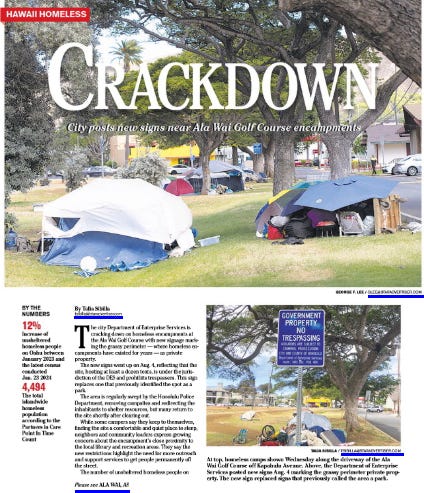
So instead of yet another me-galomania extravaganza, you get to read about a different “me” - sixty-three-year-old Melissa.1
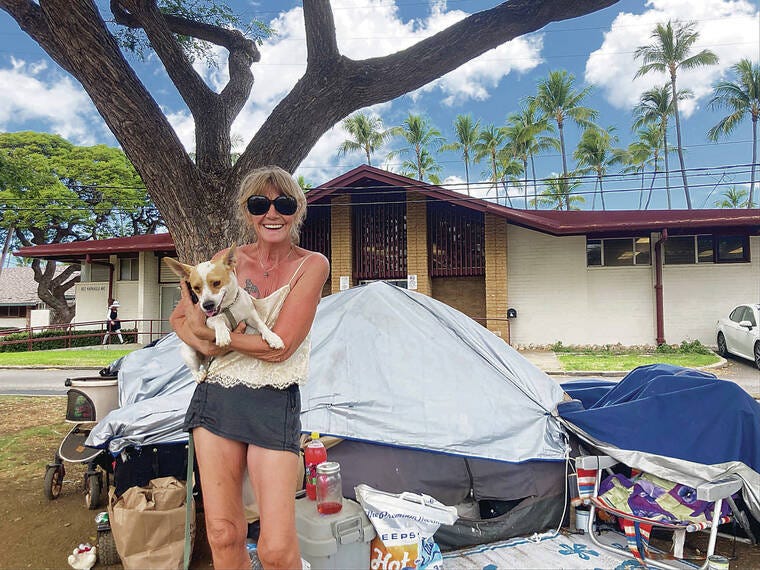
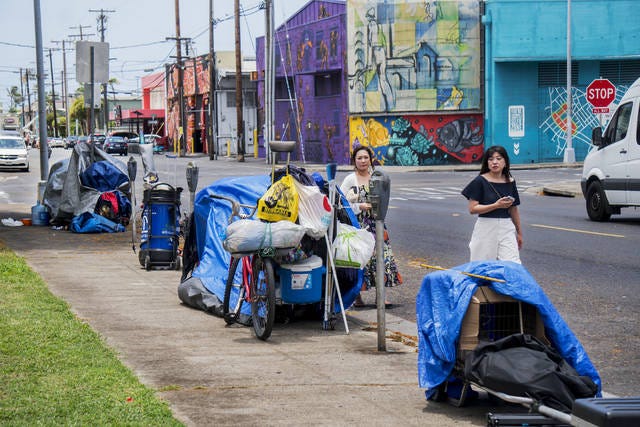
She lives in a homeless camp on the perimeter of Ala Wai Golf Course, north of the high-rise hotels of Waikiki and east of Diamond Head.
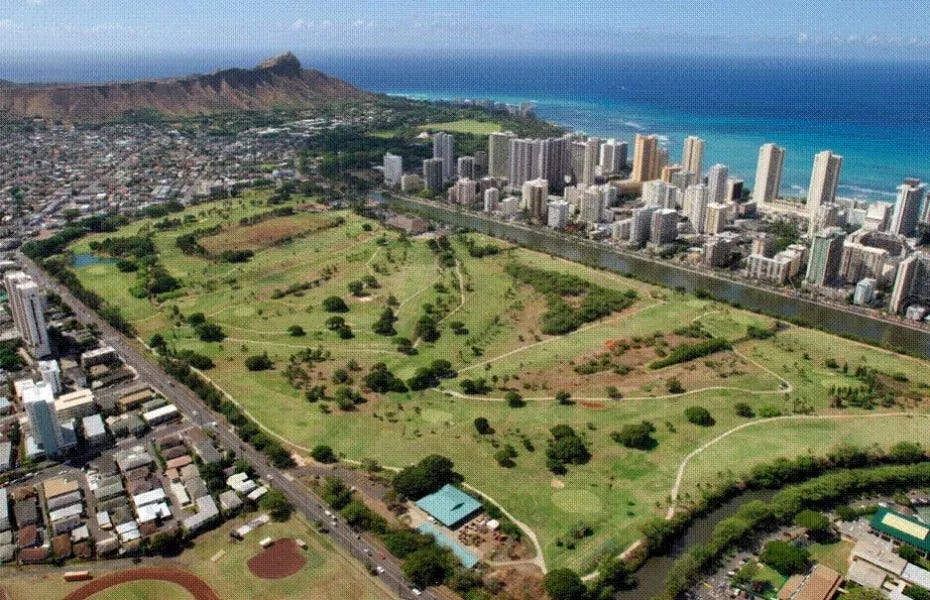
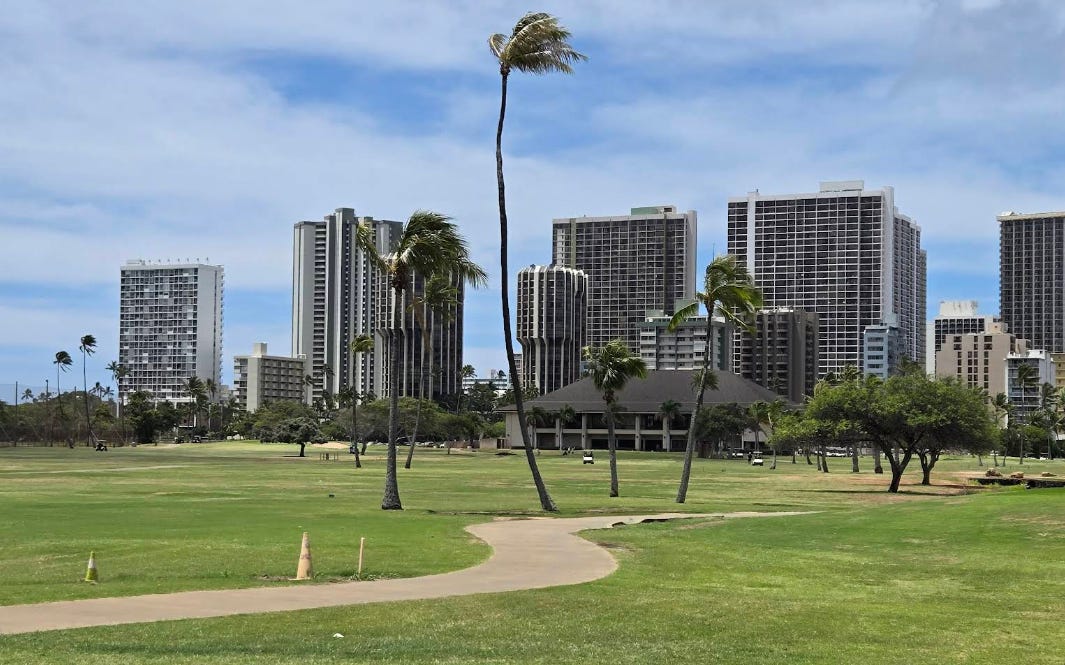
I’ve passed that golf course countless times over the past half-century. But I’ve only sporadically seen the homeless there during the past five years. Here’s a guy I spotted almost exactly five years ago when I was walking the streets alone during CONvid.
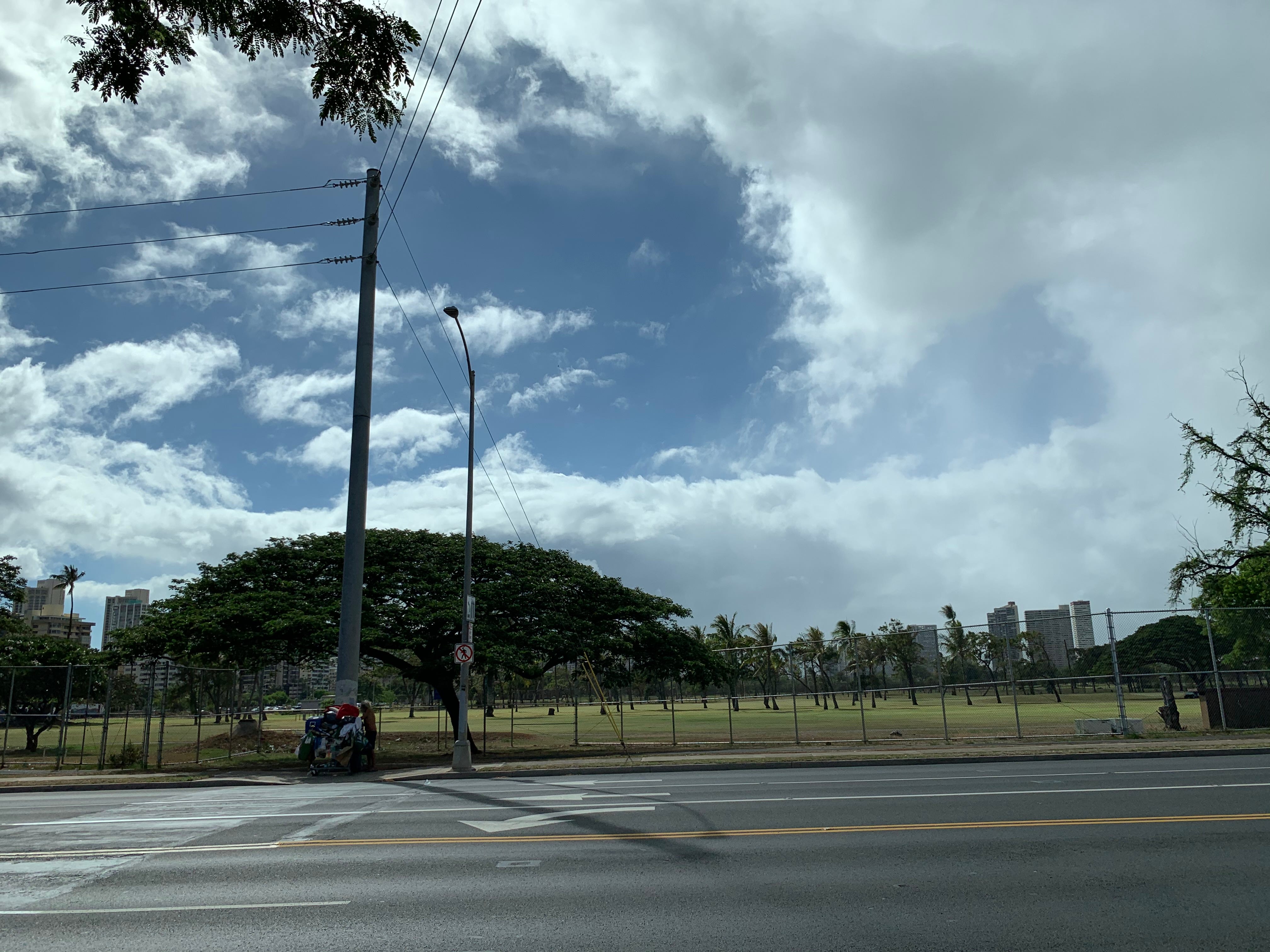
I could have zoomed in on him, but I wanted to give you a sense of the emptiness around him. The course - once the busiest in the USSA - was open … with restrictions:
Since early May [2020], when Hawaii courses reopened after a nearly two-month shutdown, the state has limited golf groups to foursomes, max. Along with that new rule, tee time intervals at Ala Wai have been doubled to 12 minutes (those intervals are expected to decrease to 9 minutes in the coming weeks), and waitlists have been done away with altogether. For health and safety reasons, no one wants a bunch of golfers hanging out and hoping for a chance to play.
That one homeless man was an anomaly in August 2020. However, judging from this video, the homeless there have multiplied since then.
This screenshot contains just a sample of “at least a dozen tents” there. Couldn’t the reporter count an exact number?
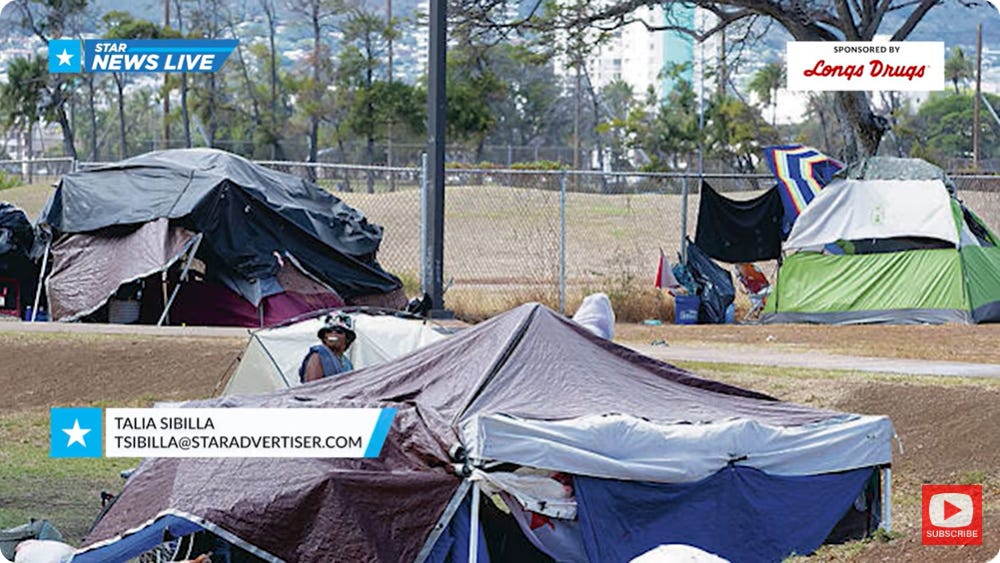
Melissa has been living there for two years. She doesn’t want to move to a shelter:
“Some have such strict rules, it’s like you’re on probation,” Melissa said. “I’ve never been in a shelter here because of the stories I’ve been told. Big bugs, thievery, nasty conditions.”
Melissa and her 3-year-old pup — a Jack Russell, pit bull, Chihuahua mix — live in a tarp-covered collapsible camping tent just a few feet from the newly installed sign.
A sign that indicates the area
is under the jurisdiction of the DES [the City and County of Honolulu’s Department of Enterprise Services] and prohibits trespassers.
A sign that isn’t there (anymore?) according to a reader:
What signs? Just went by there this afternoon [hours after the Pravda story was published] and nothing has changed. There happened to be an HPD [Honolulu Police Department] cruiser who pulled over a traffic infraction in the library parking lot [across from the golf course]. I asked him why no action on the illegal campers and his response was “work in progress” which is code for INOKEA [pseudo-Hawaiian spelling of Pidgin ay no kea ‘I don’t care’.]
The cop would have been more likely to take action if I had violated Maskless Mayor I’s lockdown.
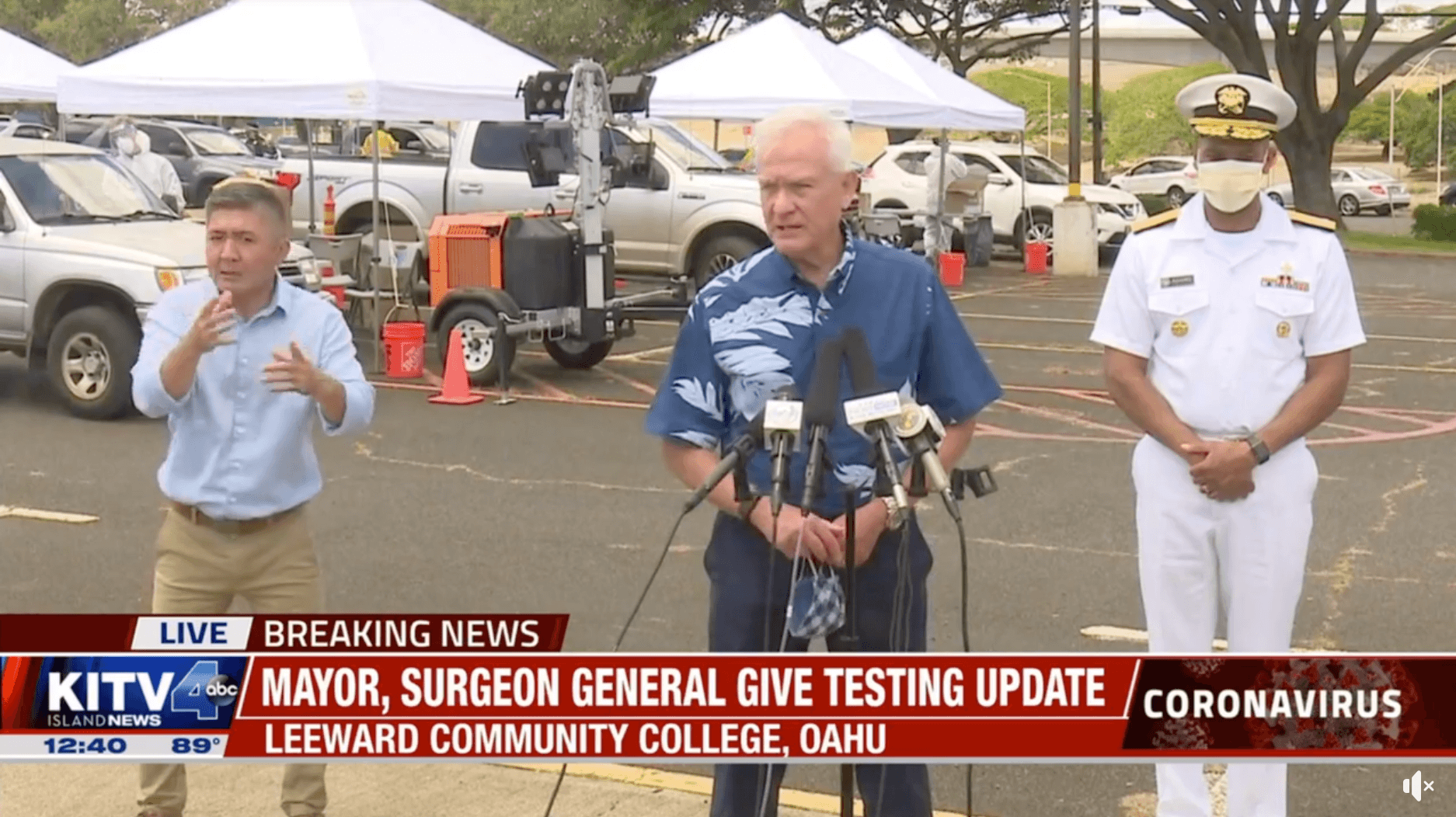
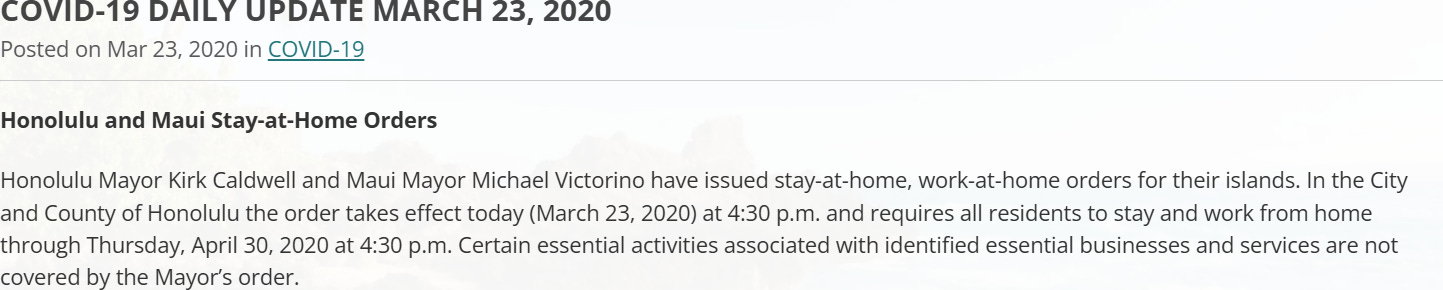
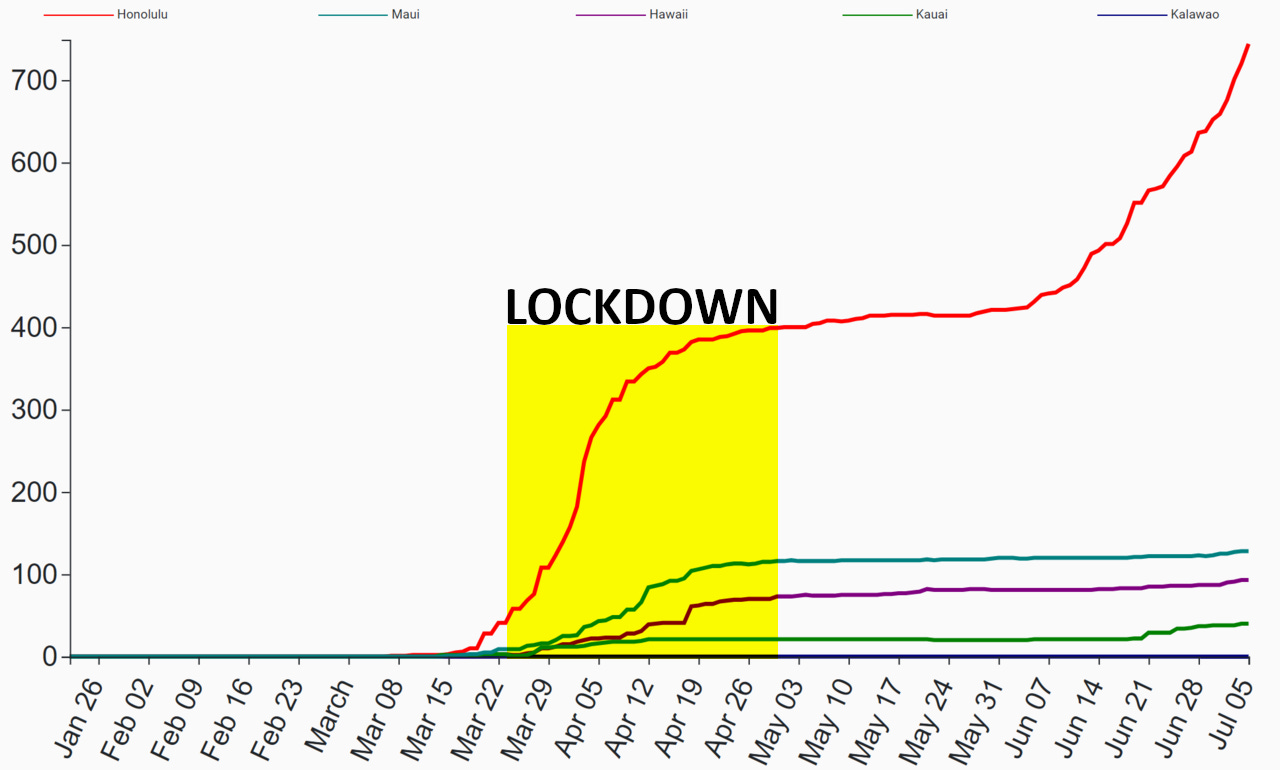
Maskless Mayor I’s lockdown failed by his own bogus metric of ‘cases’ which went way up in his domain (the red line below) during those five weeks. Note the lack of a rise of ‘cases’ in May after the end of the lockdown.

Maskless Mayor’s homeless policy was as useless as his lockdown:
In June 2018, Caldwell responded to an increasing homeless population by having legislation crafted to outlaw living in parks, sleeping and resting on sidewalks, and obstructing sidewalks with personal possessions, combined with aggressive referrals to shelters.
Prettywords didn’t translate to unobstructed sidewalks. On this island2, the number of unsheltered homeless - i.e., homeless on the street - went up 14.5% from 2,052 in 2018 to 2,350 in 2019.

Back to Melissa:
She said that many of the people camped around her are not dangerous and just want a place to live peacefully.
But is her dog dangerous? I’m not even sure it’s really part-pit bull. I just don’t want it attacking me if I happen to be walking by her … wherever she might end up next..
But she opined that their homeless state produces an automatic reaction in some people, who think that “homeless people are unsafe, they’re all drug addicts and thieves.’”
They’re not. Some are ‘just’ crazy. I see them walking into the middle of highways. Screaming at no one in particular. At least in this reality.
Crazy or not, I’ve seen a couple of homeless relieve themselves in broad daylight.
And I’ve come across a completely naked caveman-ish guy walking on a highway at night. Passing him was terrifying. I feared he’d freak out. But he - like many other homeless before him - didn’t seem to notice me.
Melissa wrestled a miniature bear stuffed animal with her dog, Marco, and reflectively added, “For the most part, anybody is just one natural disaster or one stock market crash away from being out here like this.”
But would people who lost their home due to a natural disaster or stock market crash or whatever choose to live on the street instead of a shelter? How would homeless survivors of the Maui fire answer that question?
Melissa said that Honolulu Police Department officers notified the campers of the site’s new regulations.
“Just before the signs came up, they cited some people and told them that once the signs were changed they wouldn’t be writing citations anymore, they’d just be arresting people on the spot,” she said. “I’m gonna move out of here to a different spot because I don’t like jail too much.”
This is a small island. After Melissa moves, will I see her in person?
Yeah, I know me and the first syllable of Melissa have different vowels, even in my nonstandard pronunciation, but I couldn’t resist the orthographic overlap.
The mayor of Honolulu is in charge of the entire island of Oahu which is the City and County of Honolulu.