
Messiah Complex
I has it

Last night I finally learned what the “Messiah CompleX”| (sic) storyline of X-Men was about.
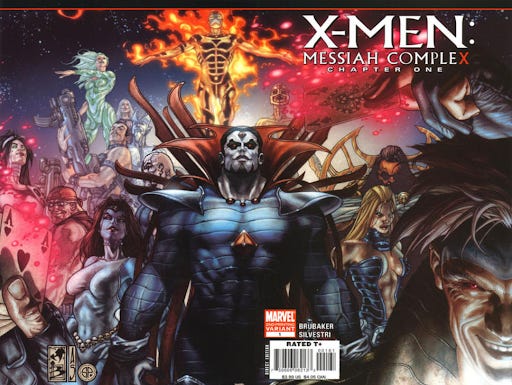
I don’t have those comics, but I do have a messiah complex, which in the strong sense is
a mental state in which a person believes they are a messiah or prophet and will save or redeem people in a religious endeavour.
I look up at the sky. The clouds above swirl as a signal from God that He has chosen me to do His will below. That He is I - and I am Him. I AM GOD!
[…T]he symptoms as a proposed disorder closely resemble those found in individuals with delusions of grandeur or with grandiose self-images that veer towards the delusional. An account specifically identified it as a category of religious delusion, which pertains to strong fixed beliefs that cause distress or disability. It is the type of religious delusion that is classified as grandiose while the other two categories are persecutory and belittled.
Why do I have delusions of grandeur? Are they are a way to cope with being “The Man Who Didn’t Belong”?

With being a “Radio-Active Man” shunned by all?
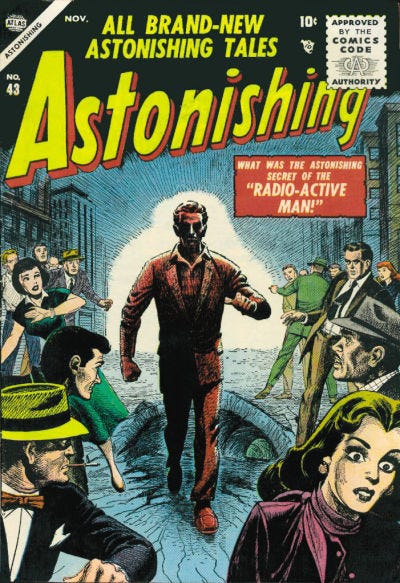
Being banned by my family during CONvid made me even more isolated than I already was.
And the few I knew who didn’t fall for CONvid fell for some fake messiah who wasn’t me: e.g., Trump.
If my family rejected me, I could make my own family.
Tim Reiterman and John Jacobs’ Raven: The Untold Story of Jim Jones and His People, an elderly Black woman told Jim Jones in 1978,
You [are] the only father I have. I love you, Father. I have no family but you.
I don’t know if she survived.
Asahara Shōkō, founder of Aum Shinrikyo, was abandoned by his family when he turned six. He changed his name - severing his ties with them - and created his own family substitute.
There are so many isolated people in the Waste today.
I also had a messiah complex in the weak sense:
a state of mind in which an individual believes that they are responsible for saving others.
[…]
In terms of the attitude wherein an individual sees themselves as having to save another or a group of poor people, there is the notion that the action inflates their own sense of importance and discounts the skills and abilities of the people they are helping to improve their own lives.
I thought I could be Morpheus, giving others the ‘red pill’.1
But that was premature - and pretentious.
I’m too aware of my flaws to fool myself into believing I’m a messiah in either sense. I can’t pretend I’m omniscient - not when I have no music background.2
I am ignorant. What Jon Atack wrote about L. Ron Hubbard more or less applies to me:
Hubbard read voraciously, mostly pulp fiction.
He was even better read than I am. I mostly read comic books, manga, and manhua. “Read” in the past tense. I haven’t seriously followed any of those media since the nineties. That’s why I was only vaguely aware of the 2007-2008 “Messiah CompleX” storyline in X-Men.
There is nothing to suggest that he studied any serious subject in depth.
One could generously suggest that I have studied serious subjects in depth, but they’re not subjects I can discuss here - and they’re subjects almost nobody cares about. So I end up writing about things I barely understand instead. Or about the one thing I think I understand best: the failure and nothingness that is me.
He read popularizations. In a lecture on study, he complained that the contemporary Encyclopedia Britannica was too difficult for him,
It’s not that hard! I got - and read - the Britannica as a child.
it was written by experts for experts, so he used the pre-World War One edition. In what appeared to be a joke, he said he intended to use children’s textbooks in future.
Hubbard would like ELI5 - Explain Like I’m Five. (I just learned that abbrevation.)

This parallels his self-confessed method of story research, described in a 1930s article called “Search for Research.” He would read the Britannica entry, and then skim through any readily available books referred to in the entry’s bibliography. The story had to be written in a couple of days, so research had to be fast.
I actually used a children’s encyclopedia to ‘research’ part of my first ‘Bible’ attempt (which, incidentally, mocked Hubbard whom I was also trying to emulate!).
Hubbard displayed no specialized knowledge of any subject, except of course Scientology, and, of course, hypnotism.
I don’t even know anything about hypnotism. I’m even forgetting the lore of my own first religion.
I’ve gone full circle. I cope with my worthlessness by fantasizing that I’m a savior, only to be unable to maintain that fantasy because I’ve failed to save anyone. Because I am worthless.
I am just an expendable slave.
How I wish I were a master! A sociopathic god!
Someone special!
Addendum: “I has (sic) it” is a catchphrase I picked up from my online reading. I had no idea where it came from until I looked it up for this post:
I had never even heard of that commercial until I Googled “I has it”. I never saw it until I looked for it just now so I could link to it.
I didn’t watch TV when it was on the air in 2010. I only had cable because it was bundled with my Internet. When I tried to cancel my cable and keep my Internet, I was told I’d pay more, so I kept paying less.
The funny thing is that I have never wanted opulence.
No, I don’t want poverty either. I’ve lived in a hundred-square-foot room. That was not fun.
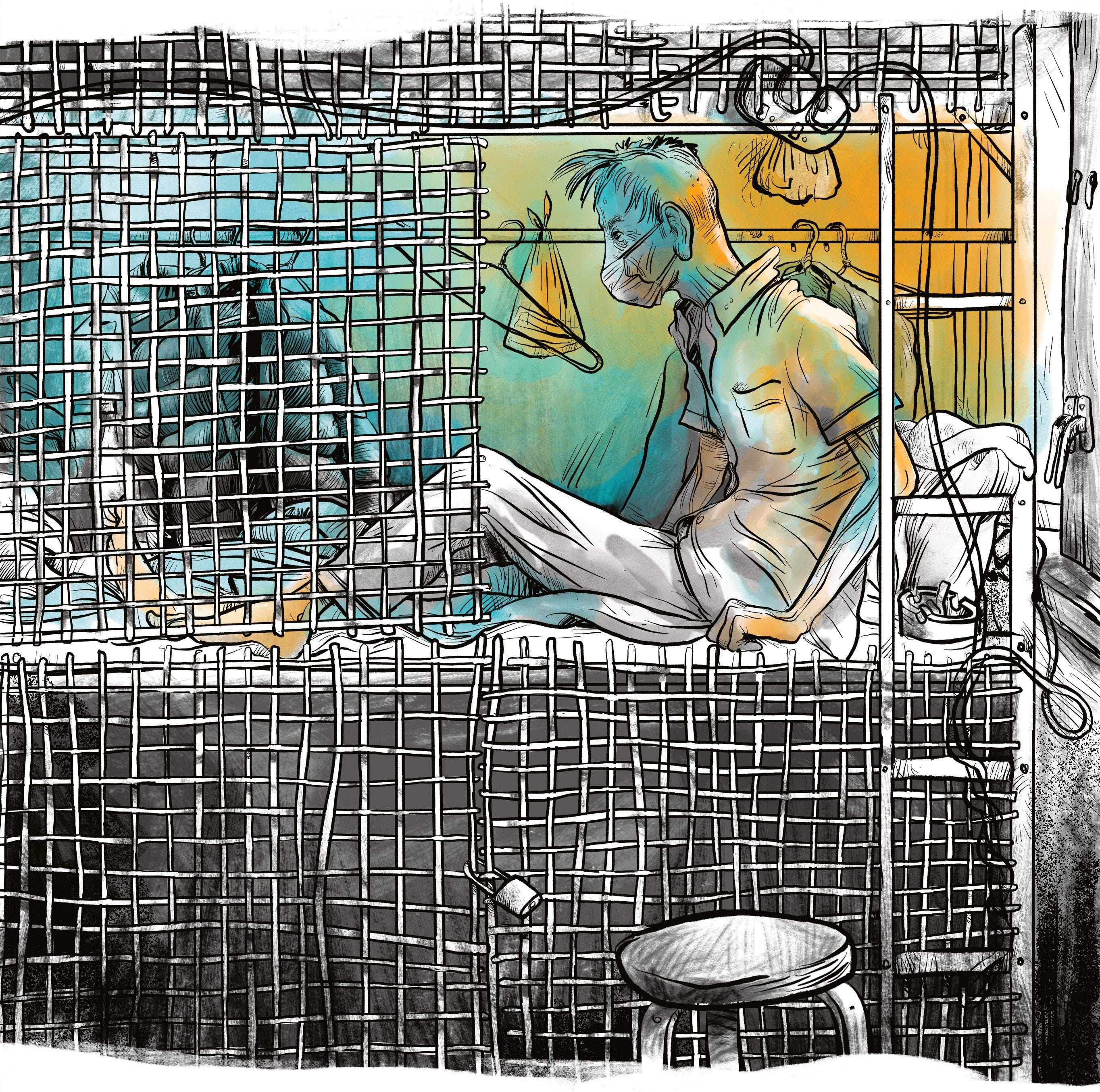
Yes, I know I could have had even less fun in a 籠屋 cage home / 棺材房 coffin home:
Each section has two to three layers of beds, which are subdivided with metal cages. With no doors, residents have to keep all of their personal belongings inside the confined space. Each bedspace is very narrow, so an adult can barely lie down, stand, or sit straight. Since residents do not have room for any extra personal belongings inside the cage home, such a bedspace is deemed to be a place for sleeping only. Cage homes are dim, cramped, and hot. The temperature can reach 34 °C (93 °F). Residents share the toilets and kitchen, which are notoriously smelly, dirty, and very simple.
What I really want is power. The lie that is authority, and the adulation, fear, and obedience that comes with it. I am God, and all people must behave appropriately in My Divine Presence … or else. BECAUSE I SAID SO.
When I see Captain America types going along with a lie doing their ‘duty’ and going off to a war that is no benefit to themselves (beyond a paycheck) or their people, I ask - why aren’t they doing it for me?
I recently heard a veteran - a literal Captain America fan - speak proudly of his service in Afghanistan. Of the supreme virtue of the slave - following orders. Befehl ist Befehl. He still believes in Godforce, the holy warriors of the USSA.
What if he believed in me?
The Morpheus analogy didn’t occur to me until I wrote this post. So no, I haven’t spent the last twenty-six years (or even the last twenty-six hours) thinking I was Laurence Fishburne. But as I type this, I realize that I did think one of the people I tried to red pill was The One! Even an Untermensch like me has come across Übermenschen, and some have “HERO” in all caps written all over them. I think of them as ‘Captain America types’.

I realized just now that as usual, I was wrong. I had swallowed common assumptions about what ‘heroes’ are like. Specifically, what they look like. I had confused form and content.
I thought people with the form prized by others would have the content prized by me. But why would there be any correlation between the two? If others say heroes look like X, and if I say heroes have Y, why would I expect the X-people (not the X-Men!) to have Y? Casting is not character; someone who could play a Marvel superhero in a movie isn’t actually a superhero - or even just a ‘regular’ hero. Real heroes don’t have to look like movie stars.
Ironically, the one I thought of as The One called me “heroic”. And I look nothing like a movie star. I’ve been told I look like (a) a homeless person, (b) Gandhi, and (c) Asahara Shōkō, founder of Aum Shinrikyo.


Obviously Gandhi and Asahara look very different - those comparisons came from two different people. The Asahara comparison came from someone aware of my m-complex - and also possibly aware of Asahara’s megalomania:
During his adolescence, Matsumoto developed a fantasy about ruling a kingdom of robots with total power and confided in his schoolmates about his aspiration to become Prime Minister of Japan.
His dream partly came true. He did have total power over Aum Shinrikyo until he got arrested.
Could his followers be regarded as robots? I imagine Eileen Barker would say no. In New Religious Movements: A Practical Introduction (1990 - before Aum Shinrikyo became infamous in the West), she wrote,
Outright rejection or ridicule by the parents in such a situation [in which their child has joined a new religious movement] can lead to withdrawal by the son or daughter and the start of a downward spiral of mutual misunderstanding and recrimination. This process is greatly exacerbated if the parents are also frightened by sensational media reports, or they have been otherwise persuaded that their child is now a brainwashed robot who is incapable of independent thought.
The implication there is that the belief “that their child is now a brainwashed robot” is as (in)accurate as “sensational media reports”.
The parents might then start to ‘see’ signs that their children are indeed ‘not themselves’. It is, however, unlikely that the converts will have been drastically manipulated by sinister techniques of mind control - and extremely unlikely that they will be suffering from any lasting (or even temporary) physiological damage. It is also very unlikely that they will be suffering from any lasting (or even temporary) psychological harm. In any case, it certainly does not help if converts are repeatedly told [by their parents, I assume] that they no longer have a mind of their own.
Barker has an entire chapter which gives me the impression she thinks mind control might not even exist: e.g. (emphasis hers),
It is probably true to say that some of the movements would like to be able to practise some sort of mind control over both potential and actual members.
I am inclined to agree. My own experience as a member of cults (loosely defined) has taught me that agency is underestimated if not simply ignored when discussing cults. Outsiders cannot imagine people wanting to sign up for such things. But people - myself include - do choose to convert. To stay. And even leave.
Reading Tim Reiterman and John Jacobs’ Raven: The Untold Story of Jim Jones and His People, I was struck by how members of the People’s Temple were not robots. They knew Jones was (insert your favorite pejorative) and yet chose to be with him. To call them “robots” absolves them of responsibility. Of blame.
I am biased to agree with Barker because the idea of people willingly submitting is even more exciting than robots obeying. That’s why I don’t think our masters will give up on human servants. They’ll keep a few around after the rest of the “useless” (to use Harari’s term) have been [redacted].
I like to believe I can think like a master. But I am not one, and I don’t feel like one.
I once knew a woman who might have been a shaman if not for Waste-rn ‘civilization’. She had the insight of the real gods (not me). She pointed out that my conscience prevented me from becoming what I call a master (I can’t remember what term she used, if any - she was not on board with my master-slave view of the world).
I think a lot of things prevent me from being a master such as genetic inferiority (which in turn may be a reason for my lack of charisma). But yeah, a conscience is a major handicap.
I’ve never heard of a course on how to eliminate that handicap. No master would want such a thing to be taught. That might (gasp!) increase their competition. Better to have their slaves compete to be more ‘moral’. More obedient.
Note the present tense. I did take an intro to music theory class, but that was over four decades ago, and I remember almost nothing from it, so yeah, I have (present tense) no background.
https://blog.nli.org.il/en/captain_america/
"I Bet You Didn’t Know Captain America was a Golem!
The very public Jewish roots of Captain America, the first superhero to punch Hitler in the face! "
https://screenrant.com/captain-america-jewish-golem-jack-kirby-joe-simon/
"Marvel's Captain America is well-known for being the de-facto patriotic superhero, created just before America entered World War II in a time of crisis to defeat Hitler and the Nazi threat. Incredibly strong, fast and agile as a result of the super-solder serum, Steve Rogers would go on to save hundreds if not thousands of lives during the war and beyond (after being thawed out of suspended animation while frozen in the Arctic ice). But Captain America's Jewish creators drew from some very personal source material: the Jewish legend of the Golem.
Writer Joe Simon and artist Jack Kirby co-created Captain America in March of 1941 in a direct response to Hitler and his army invading much of Europe. At the time, America was staunchly anti-war and would remain so until December 7th of that year, when Imperial Japan attacked the naval base at Pearl Harbor. But Simon and Kirby believed that a strong American statement against fascism and anti-semitism was necessary, and thus created a superhero wrapped in the colors of the American flag. But while Steve Rogers himself is not Jewish, every inch of Captain America's creation and costume is influenced by the Jewish Golem narrative, beginning with his creation."