
"Once Greatly Admired"
From Chicago to obscurity

My last post was about the long-forgotten yet once Rilly Important book Henry Esmond (1852).
The fate of Henry Esmond reminded me of a trilogy also named after its main character.
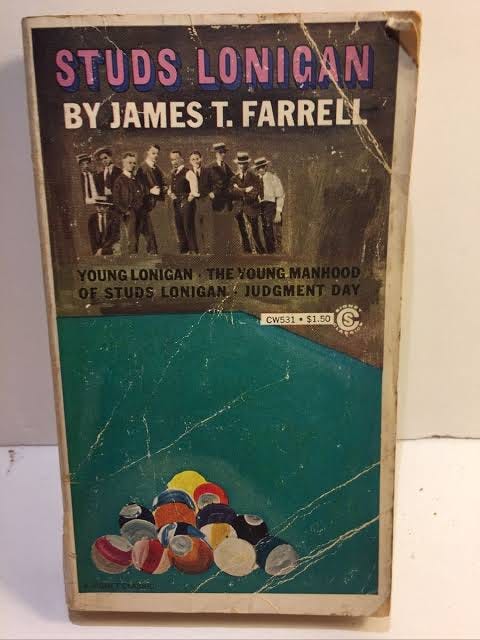
I got Studs Lonigan as part of a set of books that a Boomer had been assigned to read at an American university in the sixties. I assume some professor thought Lonigan was Rilly Important. Signet did - it published Lonigan with the “Signet Classics” label on the cover.
The word classics makes me think of the upper class. While Esmond was, as his book’s title tells us, A Colonel in the Service of Her Majesty Queen Anne, Lonigan was at the other end of the social spectrum. From a 1934 New York Times review of the second book in the Lonigan trilogy:
Studs Lonigan and his like would never hesitate at sacking a city and ravishing the inhabitants; the followers of Theodoric the Ostrogoth1 were pacifists compared to Studs, to Slug Mason, to Weary Reilley, to Hink Weber, to Jake Schaeffer, to Nate Klein, to the whole run of Mr. Farrell's gruesomely individualized proving-ground for the gangsters of Chicago's tomorrow.
[…]
Farrell drags us through his parks, cheap dance halls and hotel brawls, and shows us how they are built into the minds of his characters. He shows the adolescent gang loyalties being turned into anti-social channels. And the reader winces.
I didn’t wince when I read Lonigan in 1993, which may indicate how much standards had changed over six decades.
Farrell himself came from the environment that bred Studs Lonigan and sent him reeling soddenly into the painfully depraved New Year’s Eve party of the end of 1928. Farrell’s own biography commenced on Feb. 27, 1904, which makes him a contemporary of his protagonist. Yet Farrell climbed from his lower-class, Irish-American environment. […] He is “proletarian” enough to appear in the newly hatched Partisan Review, but the sneer that often accompanies the adjective “proletarian” has no place in describing his work. For he is proletarian by native endowments, not by any conscious process of “taking thought.” The American depths are in his bones to supply him with material for his novels.
Ah, proletarian! What a hip word that once was. ‘Proletarian literature’ was hot among the Japanese literati at the time. (Not so much among the actual proletarians - many might have had difficulty reading novels about their class.2)
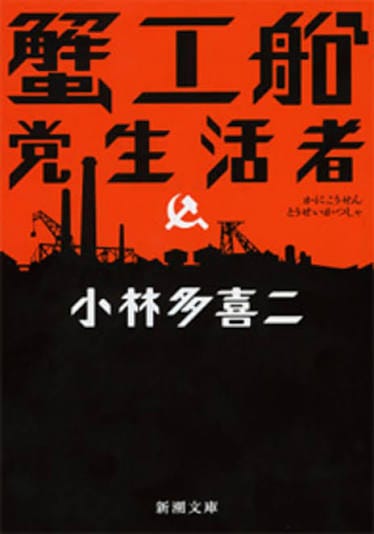
Even I was flinging the word proletarian around during my Leftist eighties, though unlike Farrell, I belonged to the “taking thought” school of posers.
And unlike me, Farrell did not romanticize the working class:
We meet Studs on the day of his graduation from parochial school. He sees himself as one tough bozo, takes no bushwa from nobody, pals around with the greatest bunch of guys in Chi. He’s going to set the world on fire. The trilogy ends some 15 years later with his death from pneumonia. He has lived a life of complete spiritual poverty and vacuity, valueless, dull, entirely wasteful. He has spent his days and years waiting for something big to happen. It never does. He comes to see that the great days, such as they were, are behind him and that all he ever had was unfocused hope. Endlessly, he and his friends, pudgy now with approaching middle age, talk about what great times they had when they were young. He remembers how he beat up a real toughie, and everyone said he was a great scrapper. One afternoon, he played a really good pickup sandlot football game; he was the quarterback. There was a girl briefly gaga about him. There isn’t much else to hang on to.
Flatly written, heavy-handed —not to say ham-fisted—in its bluntness, showing little technique or style, Studs Lonigan, enormously powerful, formed an unflinching indictment of American values, of the Catholic Church, of urban ethnic life, of capitalism; you could find in it what you would.
Ooh, sounds like prime material for ‘literary analysis’ - code-‘cracking’. More like projection. Could I see Afrofuturism in Lonigan if I tried hard enough?
Seriously, one could see Lonigan as a long expression of self-hatred. The trilogy can be summed up in three words: MY PEOPLE SUCK.3
Which in theory could make it appealing to today’s Wokists. They could view Lonigan as proto-MAGA. He’s a Christian homophobic antiseptic Wacist Eurandroppressor - White male monster - with no redeeming qualities. And with a lot of repression:
Whenever Studs had queer thoughts he had a good trick of getting rid of them. He imagined that his head was a compartment with many shutters in it, like a locker room. He just watched the shutters close on the queer, fruity thoughts, and they were gone, and he’d have a hell of a time bringing them back, even if he wanted to. He saw the shutter close in his mind now, and he puffed away and felt better.
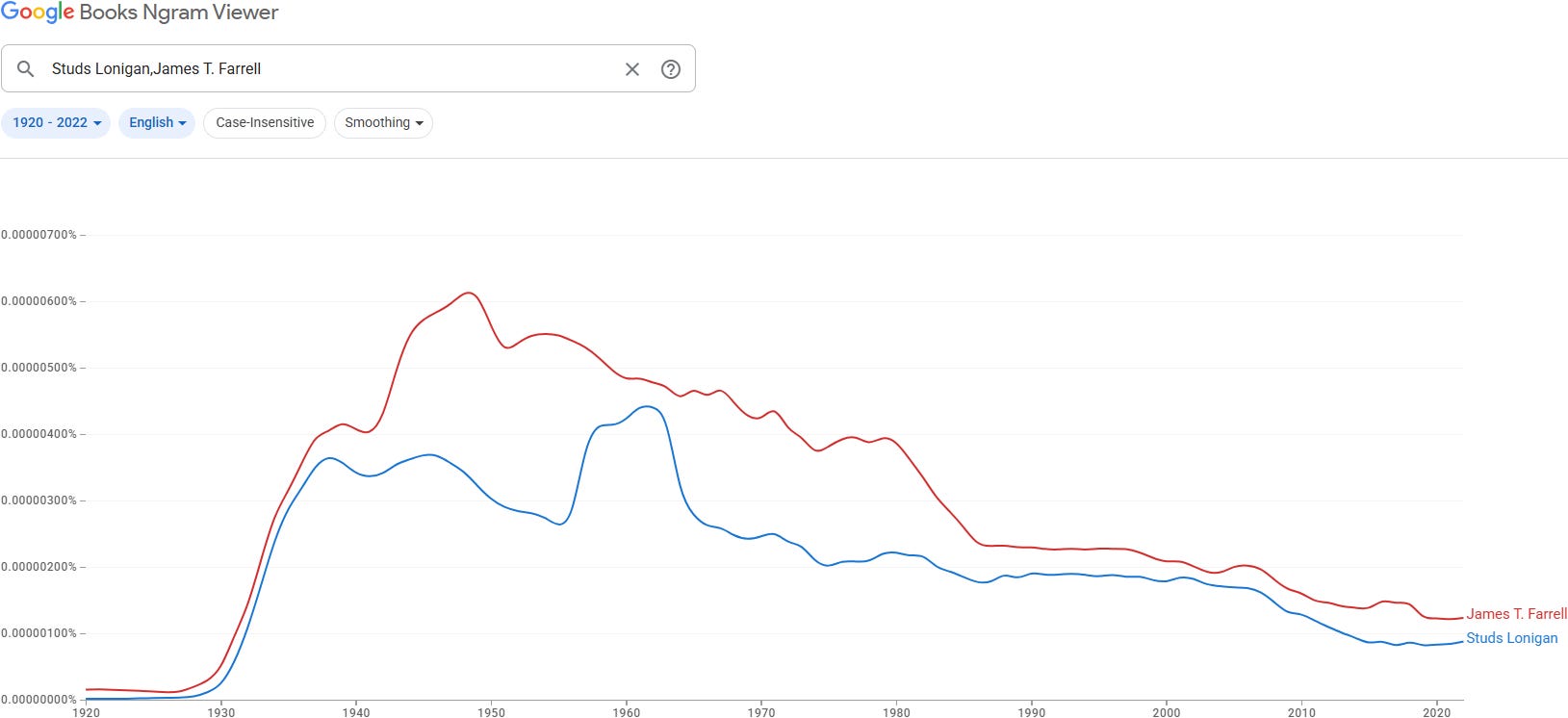
But in reality, Lonigan has long since fallen off the radar. Google Books Ngram Viewer shows Lonigan peaking in 1961 - not long before it was assigned to the class of the Boomer I knew - and then in decline ever since.
Ironically, in 1960 - near the peak of references to Lonigan - Farrell told the New York Post,
They say I’m washed up. They tell me I should have quit writing years and years ago. I finished Studs and they think I should have conveniently died then. Studs was my monument, they think. Now that he’s got his monument, they think, he ought to die.
But I won’t die; I’ll keep writing. I’ve got 40 books written right here in this apartment. 40 books. No one will publish them.
Farrell’s biographer Robert K. Landers was skeptical of the figure of 40:
Farrell was a prolific writer, but it is doubtful that he had forty completed book-length manuscripts in his apartment, and even more doubtful that any editors had read them, pronounced them boring and refused to publish them.
Did the Post accurately quote Farrell?
I just learned that he did have quite a few novels published after 1960. But none made the mark that Lonigan did. Farrell died in 1979, the year Lonigan was adapted for television.
I doubt it’ll ever be adapted again. Its ethnic world is long gone; its peoples have largely merged into a ‘White’ category divided by team affiliation - red or blue? - rather than ancestry. And interest in the plight of a cishet Irishman is zero, now that there are more colorful, more xeno options in the modern rainbow.
A modern Farrell would not be very Irish. But xe might be very Woke.
Who? For some reason Google Books shows a peak in references to Theodore the Ostrogoth in 1926, a few years before the review was written.
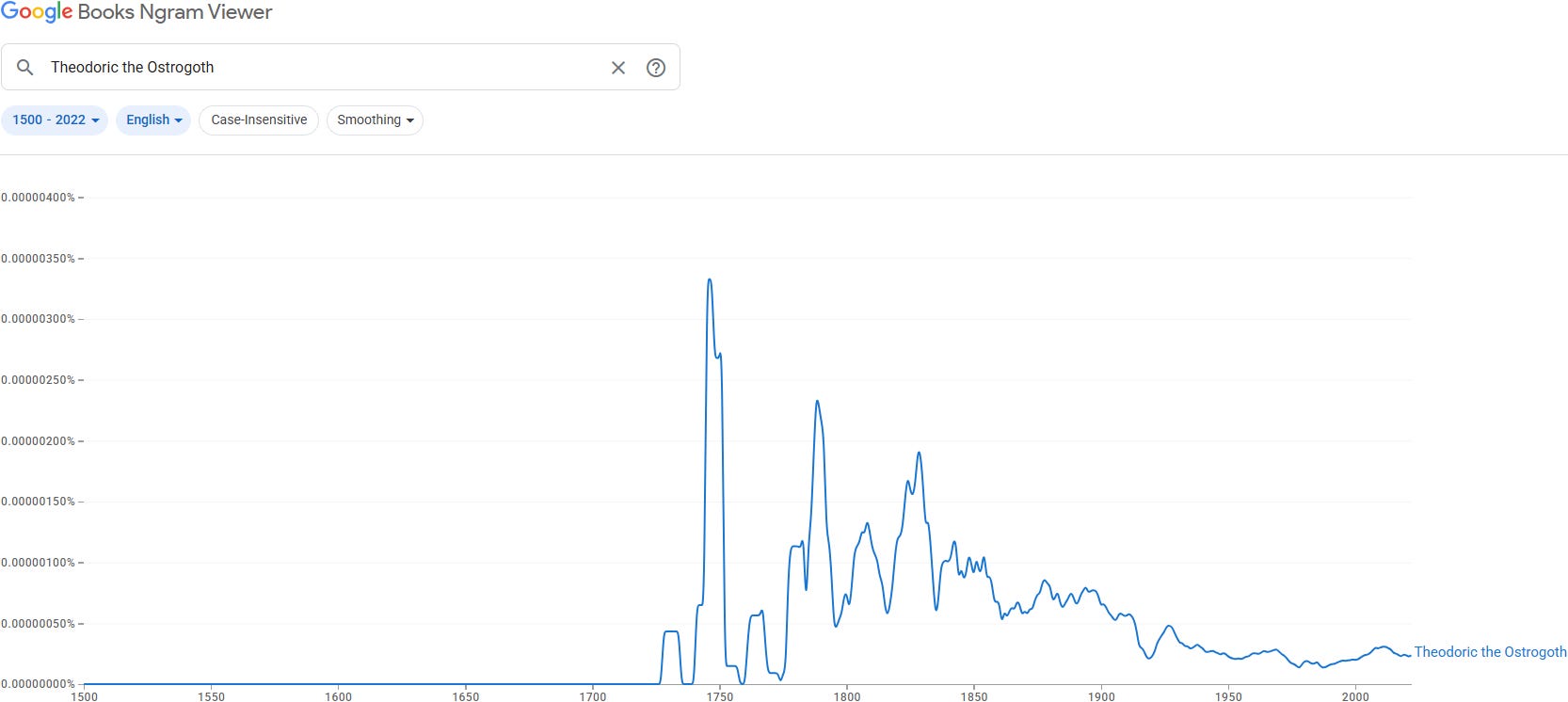
Could that peak explain why the writer had him in mind?
I would have used Genghis or Attila instead of Theodore the Ostrogoth.
During World War II, the great Japanese Sinologist 藤堂明保 Tōdō Akiyasu found that some men in his company “couldn’t read a whole sentence” in Japanese. See J. Marshall Unger’s Literacy and Script Reform in Occupation Japan (1996) for more from Tōdō and the sorry state of literacy in Japan at the time: e.g., the Imperial Japanese Army had to limit the number of Chinese characters it used in weapon names to accommodate the limitations of its conscripts. The translation is Unger’s.
I just checked and found that after the war, the character 蟹 for ‘crab’ was not required in Japanese schools. I don’t have any list of characters taught in prewar or wartime schools, but I wouldn’t be surprised if some workers couldn’t read the ‘crab’ part of 蟹工船 The Crab Cannery Ship. (The other two characters, 工 ‘work’ and 船 ‘ship’, are very common, and I would be surprised if workers couldn’t read them.)
I have written over five hundred posts without the S word, and I will continue to avoid it in the future. But I could not think of an appropriate alternative here - it suits the ugliness of Lonigan.