
Eye to Eyes
Clash of the Titans

My last post “Mono” was about my term for monolingual, monocultural people. It’s meant to be descriptive, not pejorative … though, yes, it does sound like a disease.
It's also not an absolute category. There are degrees of mono. The most mono people left on Earth today might be on this island.
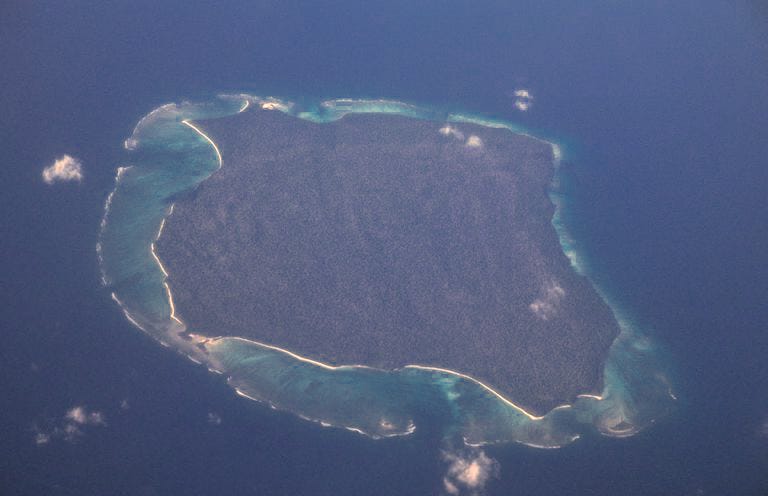

Richard Carnac Temple, chief commissioner of the Andaman and Nicobar Islands from 1895 to 1904, described the Sentinelese as
a tribe which slays every stranger, however inoffensive, on sight, whether a forgotten member of itself, of another Andamanese tribe, or a complete foreigner.
While it is true that (1) not all encounters with the Sentinelese were violent and (2) the Sentinelese did accept gifts from outsiders, they still may be the most xenophobic people on Earth. Possession of alien objects - assuming they kept the gifts - does not make them multicultural. None of them are multilingual.1
The Sentinelese are the ultimate traditionalists. Who knows, they could be the last humans left after some great disaster, carrying on as usual following the demise of the ‘civilized’ world. Being mono could save them.
Being mono probably is saving them from all the problems of the modernity package. It is also depriving them of all the benefits like Marvel movies. OMG, how could they live without Captain Murrica V: Blackest Lives Matter?2
Seriously, mono people - and I don’t just mean the Sentinelese - live without another language - and that’s okay.
One could call that cope and hence call me a hypocrite. One could call me basically mono because I never mastered a foreign language (true) and am desperate to excuse my inadequacy (maybe).
Wait, “inadequacy”? By whose standard?
Modern mono societies - though not the Sentinelese - have turned foreign languages into status symbols. This 2021 page says
the total market size of the foreign language instruction business in Japan, which includes online learning, software, language testing and study abroad, is about $8.76 billion.
Almost all those billions are spent on English. Spent? More like wasted. In the EF English Proficiency Index, Japan tied with … Afghanistan, which obviously does not expned $8 billion on English. 95 countries outranked Japan and Afghanistan, and I doubt most of them spent $8 billion on English either. Tokyo is less proficient in English than Maputo, Mozambique, which I never heard of before:
Maputo is a cosmopolitan city, with Xitsonga [the local Bantu language - never heard of it either], Portuguese, and, to a lesser extent, Arabic, Indian, and Chinese languages and cultures present. Almost 50% of Maputo speaks Portuguese as a native language as of 2017.
One might argue that Portuguese gives Maputo residents a leg up on English, since on a relative scale Portuguese and English are close while English is very different from Japanese. However, that excuse doesn’t explain how other Third World cities with languages that aren’t even related to English like Lao-speaking Vientiane still beat Tokyo.
But wait again - I could argue that $8 billion wasn’t “wasted” if the point was signalling, not proficiency.
One of my host fathers in Japan was a medical doctor, which meant that he had studied English for at least ten years. Yet he was relieved when he met me for the first time because he feared he’d get some exchange student whom he couldn’t talk to. English was just a means to the end of getting into medical school. It had no relevance to his life once he took his last English exam. It was a signal that he was a good student, not a practical tool - a means of communication. Everything he really needed to know was in Japanese.
He had what I call mono privilege. Maybe a better term would be megamono privilege because it only applies to speakers of big languages who have lots translated for them. And lots written in those big languages: e.g., Japanese is the third most common language for books in the world and has the sixth largest Wikipedia. The average Japanese person has no use for English. They are not going to meet English speakers in real life. They can watch English-language shows and movies with Japanese subtitles or dubbing. They are content with the massive Japanese media ecosystem.
The same can more or less also be said for English speakers. “More or less”, because English speakers are more likely to encounter non-English speakers … but the latter are likely to know at least a little English. The megamono privilege of English speakers is off the scale. Hence it is no surprise that English speakers are highly unlikely to master a foreign language.
They are the opposite of the 250 or so Kri, a people apparently at the bottom of the totem pole in the Laos-Vietnam border area:
Traditionally, the majority maintained a nomadic outdoor lifestyle, inhabiting trees and caves until 1993, when local authorities compelled almost all the Kri to abandon their customary living practices and adopt more sedentary living arrangements.
Kri men3 have to be poly - they speak not only Kri4, Lao, and Vietnamese but also Saek5 and Bru6, languages of minorities bigger than they are (10,000 and 300,000 people, respectively).

I doubt any of the Lao, Vietnamese, Saek, or Bru speak Kri. And I bet the Saek speak Lao (there are no Saek in Vietnam anymore7) and the Bru speak Lao and/or Vietnamese. Ethnic Lao and Vietnamese8 who know any minority language might be even rarer than the minorities themselves.
Is a Kri man ‘superior’ to some random monolingual native Japanese or English speaker? Notice how his version of poly is not the kind valued in Japan or the West - only linguists in those places care about Saek or Bru (and almost nobody has even heard of Saek or Bru). And even Lao and Vietnamese do not have the cachet of, say, French, the language of the former colonial rulers of Laos and Vietnam. I knew kids who went to a French school in … Hawaii, where French is useless … but still has prestige. Unlike Lao and Vietnamese, which are both much more useful in Hawaii.
I’m running out of time, so I want to get to the metaphor underlying my title. Ignore the prestige aspect of poly and focus on how poly people can function in multiple worlds. Contrast that ability with the megamono privileged who know only one world. I see polys and monos like the Masked Rider Stronger (1975) villain Titan, who was initially one-eyed but later became “hundred-eyed” (not literally, but that’s how he was described).
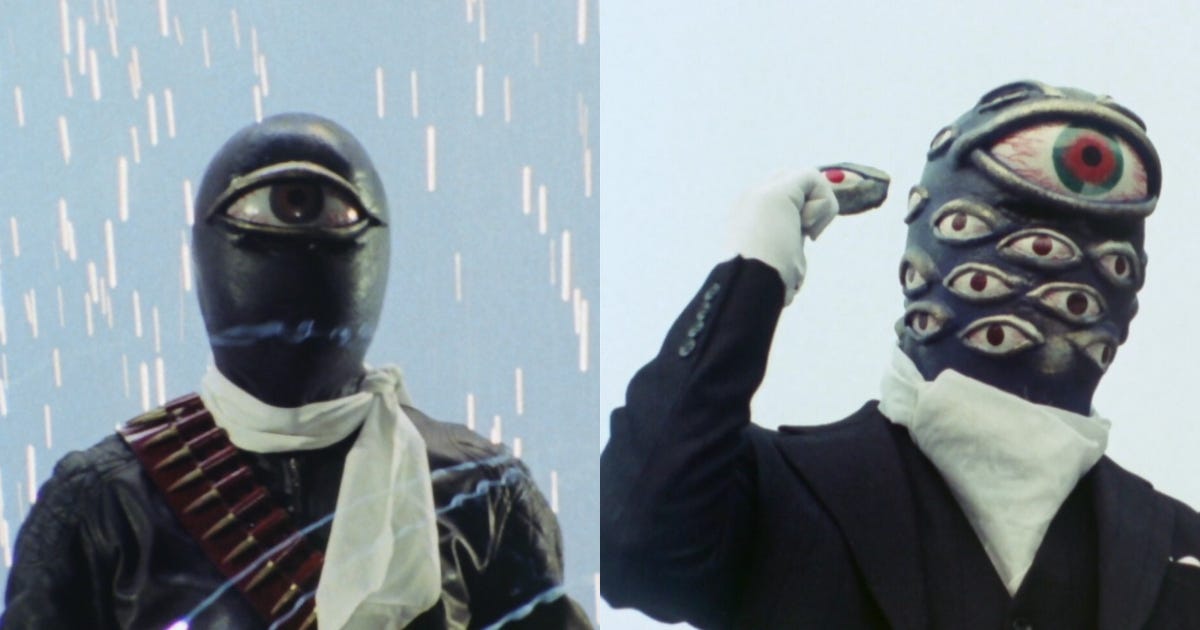
Can monos and polys see eye to eyes?
If I dare to put myself in the poly category despite my English dominance, my experience leads me to say no. I feel like I’m not getting through to the Anglo monos I know.
Maybe the failure is mine. Maybe I’m not conveying what I see as I read the Koran, the Rigveda, Buddhist scripture, etc. in the original.9 And it’s hard for me to put myself in their shoes, to imagine a life within Christian guardrails labelled only in English, the language of the King James Bible.
Symmetrical blindness?
Diversity is a perpetual problem. And I’m not talking about race or religion or whatever. We’re all different. We’ve all experienced different things even if we all live in the same ‘homogeneous’ community. No two people have total experiential overlap. Mind-melding is fiction. True empathy is elusive.
Note my use of the present tense. In 1895, Royal Navy officer Maurice Vidal Portman met a man thought to be Sentinelese living among the Onge. He was able to speak Onge, but it is unknown whether he remembered any Sentinelese. Even if he did, a bilingual individual is distinct from a polyglot people.
The Sentinelese are reported to have “dark, shining black” skin that would make them blacker than most American Blacks, including any in this movie that I made up because I can’t be bothered with the Marvel Cinematic Universe. I find American skin color-based discourse about race to be absurd because many Blacks have lighter skin than I do. The talk about skin color disguises what really interests Americans: the presence of sub-Saharan African ancestry.
Kri men have more contact with the non-Kri world than Kri women: e.g., some men serve in the Lao military and a few have even been Buddhist monks.
Kri is a relative of Vietnamese. It is, very roughly speaking, what Vietnamese might have become if the ancestors of Vietnamese speakers had not been under Chinese rule for a millennium. Vietnamese has been massively Sinified. It is full of Chinese borrowings (including most Vietnamese names - Nguyễn is from Chinese 阮, once pronounced something like nguyen in Chinese). Kri, on the other hand, has no Chinese influence.
Saek is a relative of Lao.
Bru is a distant relative of both Kri and Vietnamese.
The Saek migrated westward from northern Vietnam. The names of their former villages and a “city” in Vietnam were still preserved in Saek oral lore as recently as the 1960s.
I specified “[e]thnic” to exclude Lao and Vietnamese citizens who speak Lao and Vietnamese as a second language. 47% of the people of Laos belong to 148 non-Lao ethnic groups.
I do not mean that I am trying to sell any religion. I do not believe in any religion. I do enjoy diving into other ways of thinking.
"Being mono could save them." I think about this a lot and inverted. Like what will happen to the amish and uncontacted tribes and cats and dogs when/if friendly AI hard launches? And inverted, what if that already happened and we're already the dogs and cats and uncontacted tribe.
(If that's the case I wish the real AI/aliens would save me/us. STNG prime directive logic is ethically bankrupt.)
We're all dead anyway, either by the sun running out of hydrogen or evolution and departure.
"The megamono privilege of English speakers is off the scale."
Would love a post from you on how this came to be. My off the cuff impression is air traffic control/net/phone first mover.
"Symmetrical blindness"
You desperately need to read peter watts firefall triology.