
Ride the Van
Hauling the hakugei to the top

My last post was titled 白鯨 Hakugei - a special Japanese term for ‘white whale’ apparently coined for the translation of Herman Melville’s Moby-Dick. When Hakugei, I mean, Moby-Dick first came out, it got mixed reviews. The London Spectator said it has “empty” phrases, “repels” the reader, and “induce[s] weariness or skipping”. The Wikipedia entry for Herman Melville does not even bother to mention the book’s immediate reception and skips to the next period of his career, titled “Unsuccessful writer”:
The New York Day Book published a venomous attack on September 8, 1852, headlined "HERMAN MELVILLE CRAZY" [after the publication of his next novel, Pierre: or, The Ambiguities].
So much respect. Clearly Moby-Dick did not make Melville a literary god overnight, or as we will see, in his own lifetime. Even the New York Daily Tribune’s positive review of Moby-Dick mentioned “lawless flights, which put all regular criticism at defiance” and compared it to “the favorite and fragrant first-fruits of his genius, the never-to-be-forgotten Typee [1846].”
Never?
Melville could not find a publisher for his next novel Israel Potter and initially had it serialized between 1854 and 1855 before it was collected in 1855. His final novel, The Confidence-Man (1857), “received reviews ranging from the bewildered to the denunciatory.”
He spent most of his last years as a customs inspector. During that period, he wrote Clarel: A Poem and a Pilgrimage (1876):
Publication of 350 copies [of Clarel] was funded with a bequest from his uncle in 1876, but sales failed miserably and the unsold copies were burned when Melville was unable to buy them at cost. Critic Lewis Mumford found an unread copy in the New York Public Library in 1925 "with its pages uncut".
In The Recognition of Herman Melville (1967), Hershel Parker wrote that during that period
[….] Melville was only perfunctorily mentioned in textbooks, encyclopedias, magazines, and newspapers.
In the years leading up to his death and immediately beyond, Melville was in “near-oblivion in America”, though he had
growing recognition in England by a few literary men. Apparently, his books were passed lovingly from friend to friend among groups of English writers.
I assume the average Englishman - or American - had no idea who he was. In the early twentieth century, he was “assigned […] a niche with the minor fiction writers,” and colleagues of his few fans “uneasily tried to explain away” their fascination with someone Outside the Canon - OMG!
How did he get inside the canon? He rode the van.
Carl Van Doren (PhD, Columbia) hyped Melville in the Cambridge History of American Literature (1917), declaring Moby-Dick to be
the best of his, and one of the best of American, romances [... T]he immense originality of Moby Dick must warrant the claim of its admirers that it belongs with the greatest sea romances in the whole literature of the world.
The effect of that declaration was not immediate. Van Doren commissioned Columbia professor Raymond Weaver to write an article on the centennial of Melville’s birth for The Nation in 1919. This hiiiighly educated eliiiite man confessed,
I knew almost nothing of Melville-beyond the fact that [Columbia professor] Brander Matthews had mentioned him in course [sic]. I’d begun Typee - and stopped at the beginning.
Remember “the never-to-be-forgotten Typee”? A Columbia god couldn’t be bothered to finish it sixty or so years later.
That god found many books by Melville in the Columbia library - but no books on Melville.
Weaver would go on to write the first biography of Melville. He was Van Doren’s greatest convert to the cause of The Book.
Not that Van Doren was slacking off. In 1921, he pushed Melville further in The American Novel:
[… A]n acquaintance with his [Melville’s] work is a sign by which it may be learned whether any given American knows the literature of his country.
So I don’t know the literature of ‘my’ country. I’m so hurt. Wah.
Whatever. I don’t need to speak in code, at least most of the time. On the other hand, Parker gives me the impression that part of the growing appeal of Melville to the literati of the 1920s was as “ammunition for critical attacks on contemporary values,” citing Weaver’s biography and a later 1929 biography by Lewis Mumford. Moby-Dick as coded anti-flapper message? I say it’s an Afrofuturist fable, so why not?
Not every smahhhht person bought the NuNarrative. Parker wrote,
Throughout the 1920’s there were warnings that the enthusiasm for Melville was exaggerated and that he would eventually be assigned to a respectable place on the shelf of minor American fiction. In the early 1930’s some editors of American textbooks began quietly to omit from their revised editions the Melville selections dutifully inserted during the 1920’s. Ludwig Lewisohn in Expression in America (1932) announced baldly: “It will be seen at once that I consider the recent reestimate of Melville to have somewhat overshot the mark,” and he denounced the younger generation of Melville enthusiasts as “both deceived and self-deceived.”
But in 1938, Princeton English professor Willard Thorp (PhD, Princeton)
established Melville as a major American writer to be studied in all American colleges
with a biography in the Melville volume of the American Writers Series.
In the forties a number of Yale dissertations were written about Melville.
And so by the fifties, Moby-Dick made it into Encyclopaedia Britannica’s Great Books of the Western World as volume 48, despite series progenitor and former Columbia professor John Erskine (PhD, Columbia, DLitt, Amherst and Columbia)’s threat to drop it if Walt Whitman were excluded (and he was). Moby-Dick had been absent from the proto-Great Books Harvard Classics (1909-1916). It had come a long way.
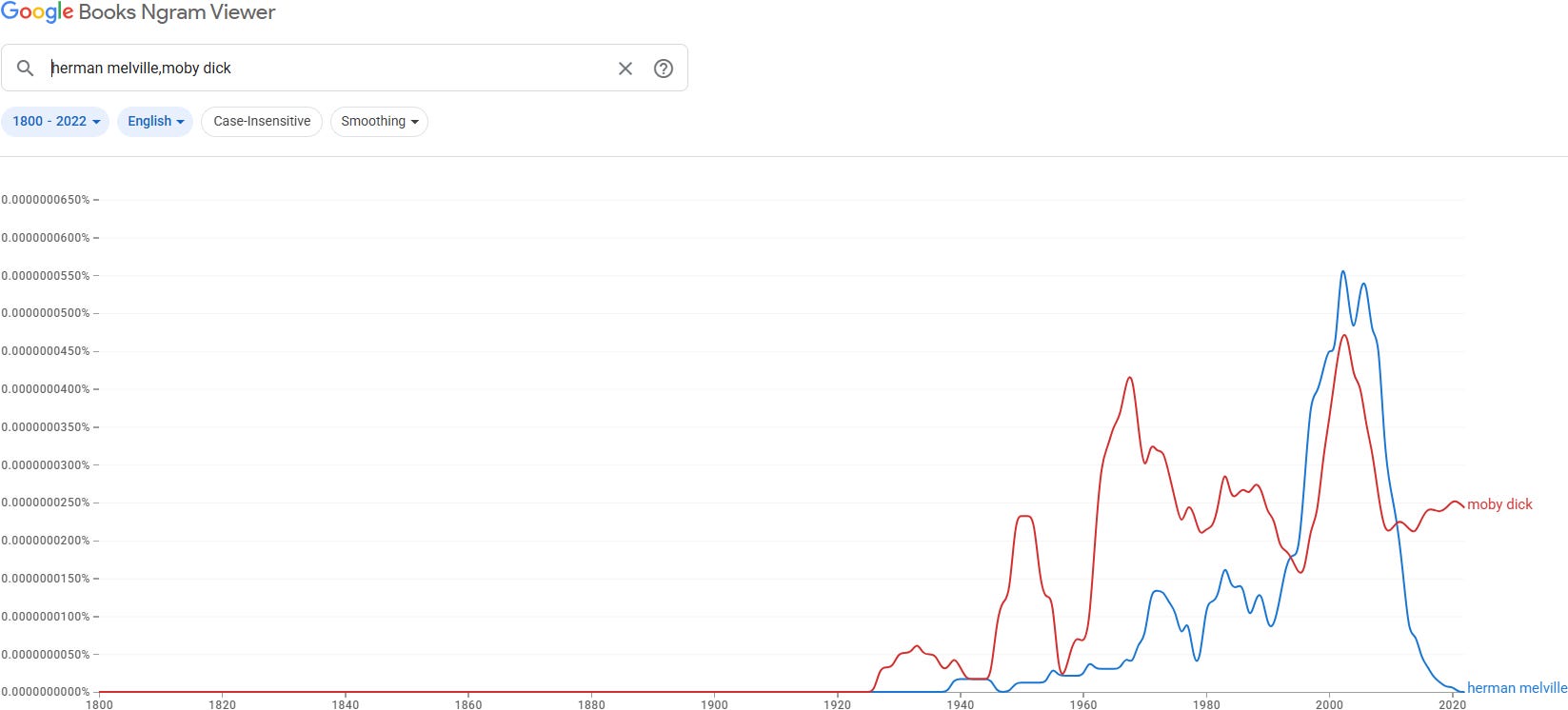
And then it came down. Google Books Ngram Viewer shows that “moby dick” peaked in 1967 if we ignore the slightly higher 2002 spike, possibly a result of the 2002 Melville biography that Parker cowrote.
To Kill a Mockingbird has eclipsed Moby-Dick:
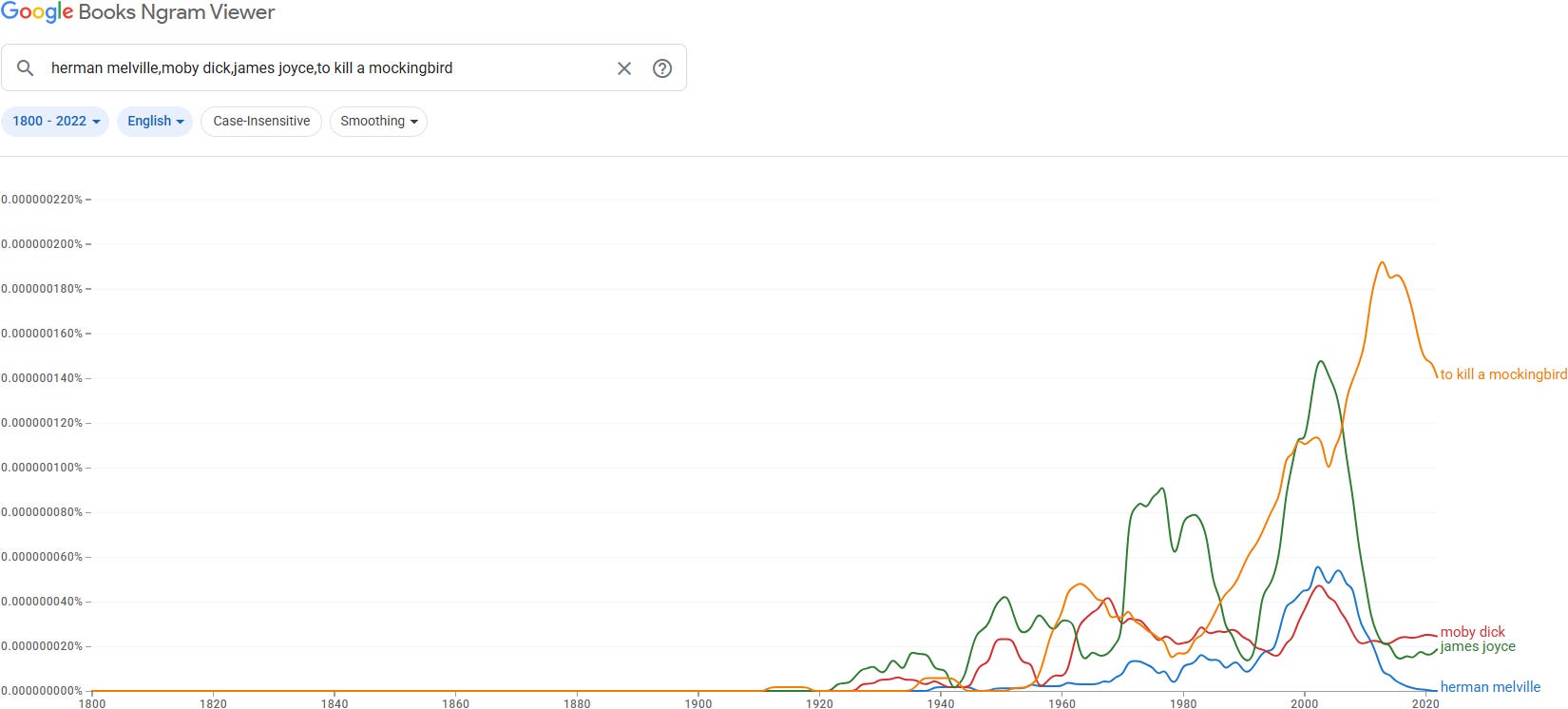
Guess which book I had to read in school. Mockingbird is shorter and easier to read, and perhpas most importantly, its tale of Godracial innocence is irresistible to Goodwhites. But even its popularity has levelled off. Just like James Joyce’s.
In our exciting Diverse!™ world, we don’t need no more dead Europpressive authors. The next generation of Van Dorens (PhD, Ivy) will declare this or that Dark book to be ‘literature’, and all ‘bright’ (signal-receptive) people and wannabes will agree.
The canon is a CONstruct - the product of power.
Is mockingbird a tale of self annihilating obsession? I doubt moby dick invented the idea, but my assumption was basically that it was the most resonant and complete articulation of the concept at the time such lists (as the canon) were being cemented.
But I mean, I take it all with salt because if the news is bad, think of history. Basically everything human society does is 90% bullshit at best.