
Build Up
Seeking the seeds of my transhumanism on the fiftieth anniversary of Steel Jeeg

Last December, Michael Ginsburg gave me the idea for the two-part transhuman scenario that I posted last week.
I still haven’t watched any Years and Years beyond that one chilling clip that he posted.1 I did, however, finally get around to reading the episode plot summaries for the series on Wikipedia. Bethany, the transhuman in the clip above,
has cybernetic implants surgically installed in her hand, a step to becoming transhuman [… Later she] is fitted with a brain implant that enables her to interact directly with the internet, but also to spy on her family.
By the end of the series in 2034, she seems to become a hologram, or at least she can project herself as one if her physical body still exists. I can’t tell from Wikipedia.
Years and Years’ transhuman element got me thinking about the transhuman elements in the Japanese heroes that I grew up with in the seventies and eighties.
Today is the fiftieth anniversary of Steel Jeeg. Meet its cyborg hero, Shiba Hiroshi.
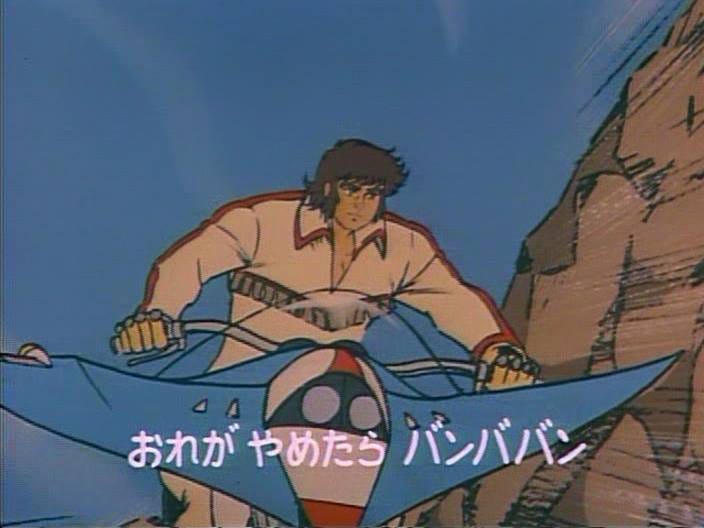
When he wears special gloves and strikes his fists together …
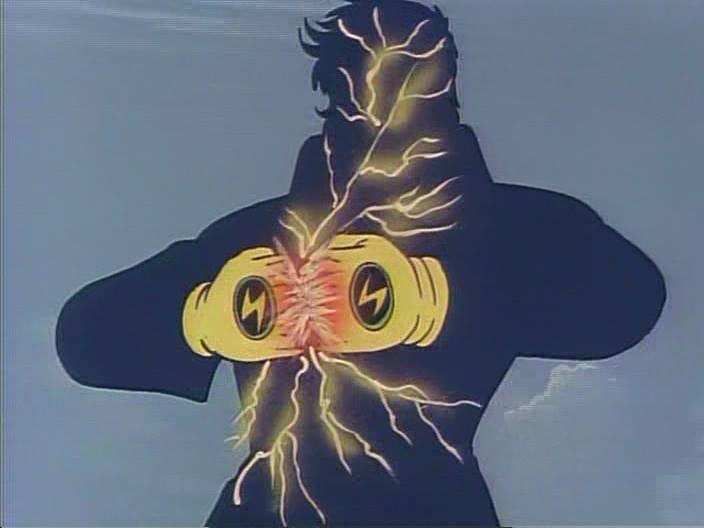
… the machine hidden within his flesh emerges.
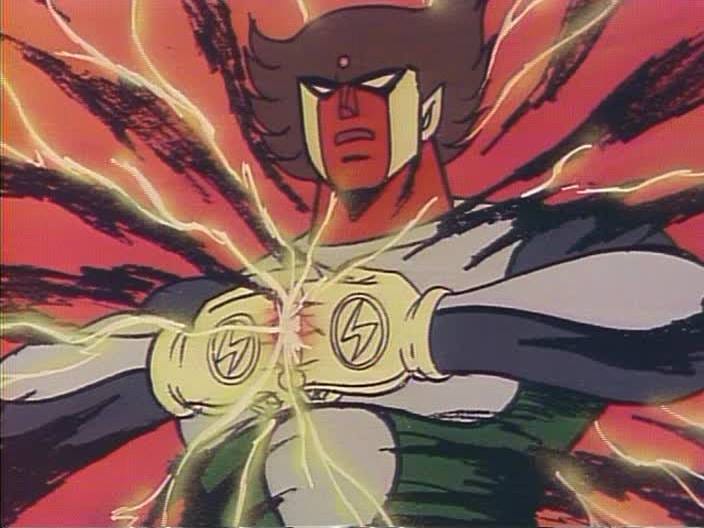
He curls up into a ball …
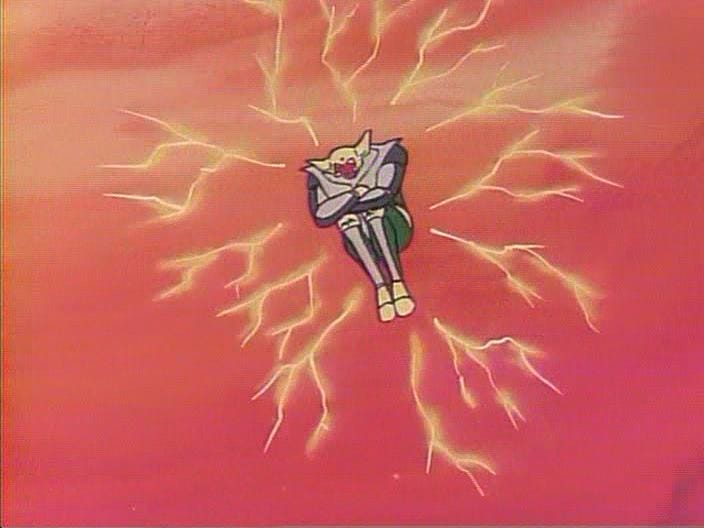
… and transforms into the head of Steel Jeeg.

Jeeg’s other parts are magnetically attracted to him.

The pieces “Build Up!” (The English phrase is used in the show.)
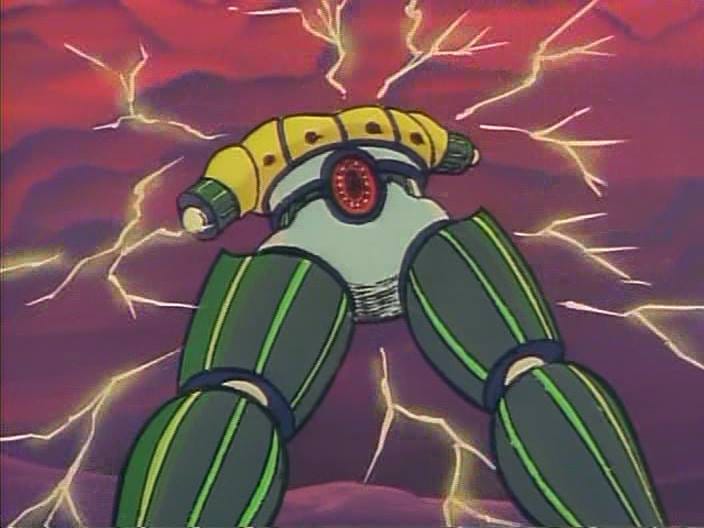
And once Hiroshi attaches himself to the built-up body …
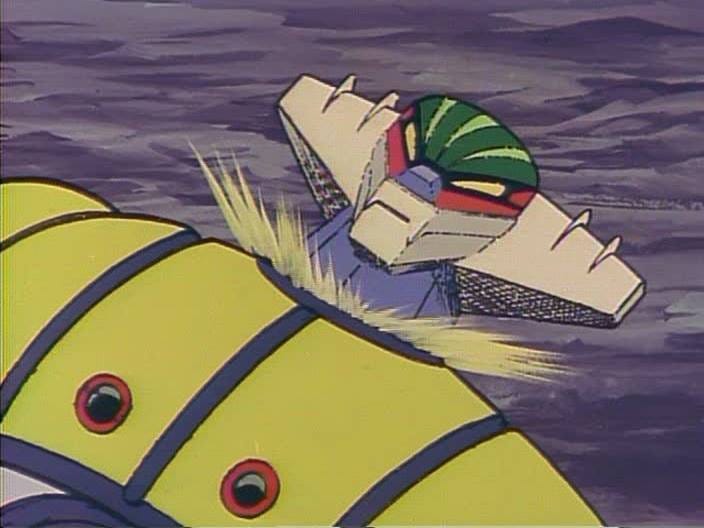
… Jeeg is ready to do battle with evil forces from ancient Japan!
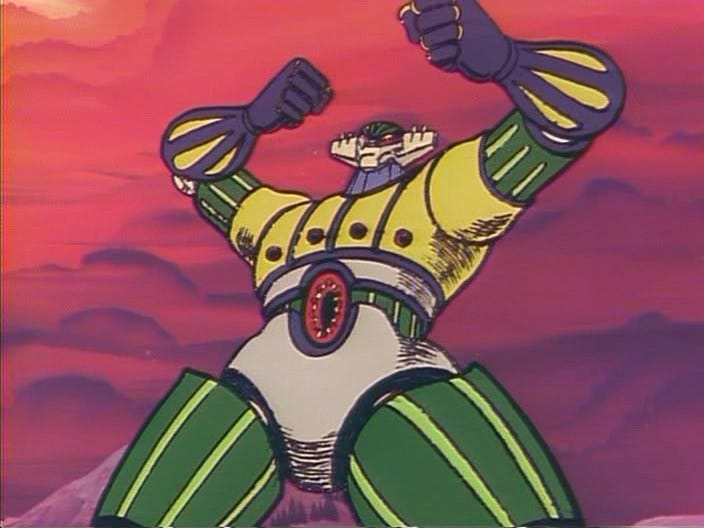
Good modern tech vs. evil premodern mystics (Himika, the queen of the bad guys, is named after the famous shaman Himiko) … the war on the old ways is so obvious to me now.

Jeeg isn’t particularly popular or famous; I’m only mentioning it because today happens to be its birthday.
Ishinomori Shōtarō’s Cyborg 009 (1964) is much more famous and is perhaps the ancestor of the Japanese cyborg superhero genre.
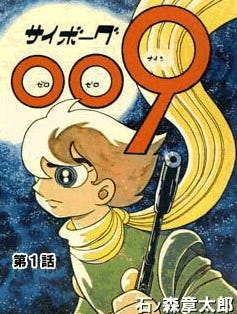
Wikipedia: Nine people from around the world are kidnapped by the evil Black Ghost organization, led by the tyrant Skull, to undergo experiments that would allow him to use them as human weapons to promote the production of cyborg warfare. While he succeeds in converting the group of nine into cyborgs with superhuman powers, his most reputable scientist, Dr. Isaac Gilmore, helps the cyborgs escape to rebel against Skull and Black Ghost. The nine cyborgs – from which the name of the series is derived – band together in order to stop Black Ghost from achieving its goal of starting the next world war by supplying rich buyers with countless weapons of mass destruction.
Even bigger than Cyborg 009 is Ishinomori’s Masked Rider series that started in 1971. New Masked Rider series are still being made today. I stopped watching Masked Rider shows in 2005, so I don’t know whether the cyborg aspect has been completely lost.
The very first Masked Rider, Hongō Takeshi, was turned into a cyborg against his will by the secret organization Shocker.
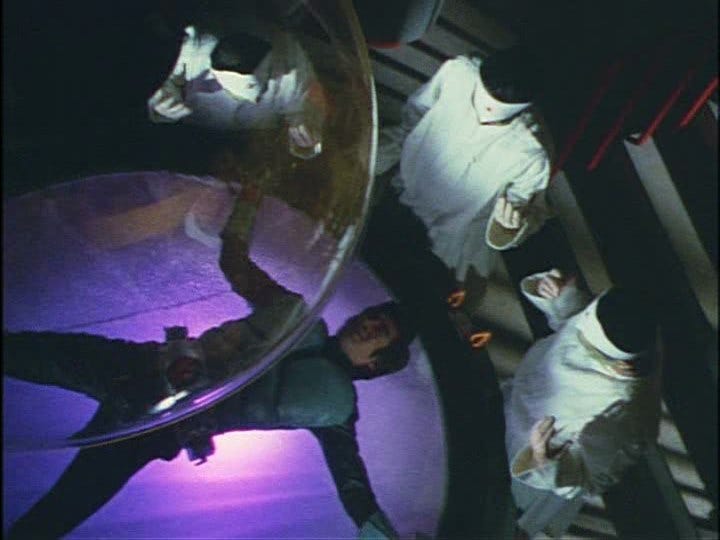
He fled Shocker after his involuntary surgery and turned their implants against them as Masked Rider, a man with grasshopper powers and a super motorcycle, the Cyclone.
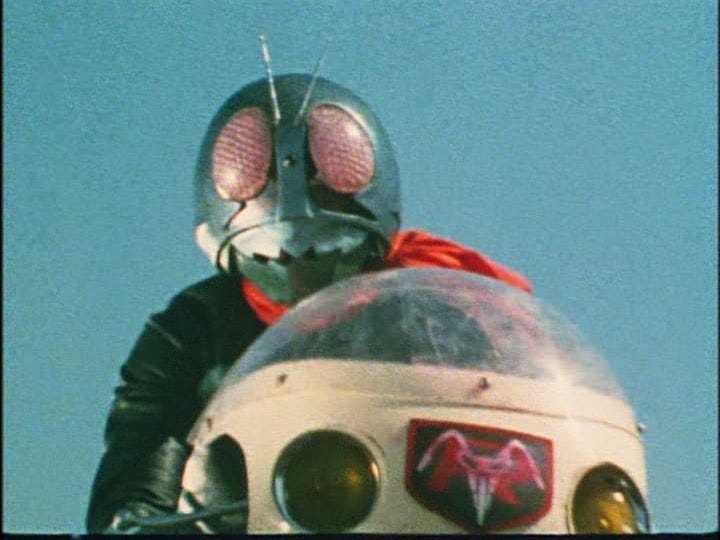
Many more Masked Riders followed, and at least all the ones from my childhood were cyborgs.
Ishinomori’s Akumaizer 3 (1975) turns fifty in two days. It’s about an entire society of subterranean cyborgs, the Devil Clan, invading the surface world - and three Devil Clan members (pictured) who turn against their people to save us.

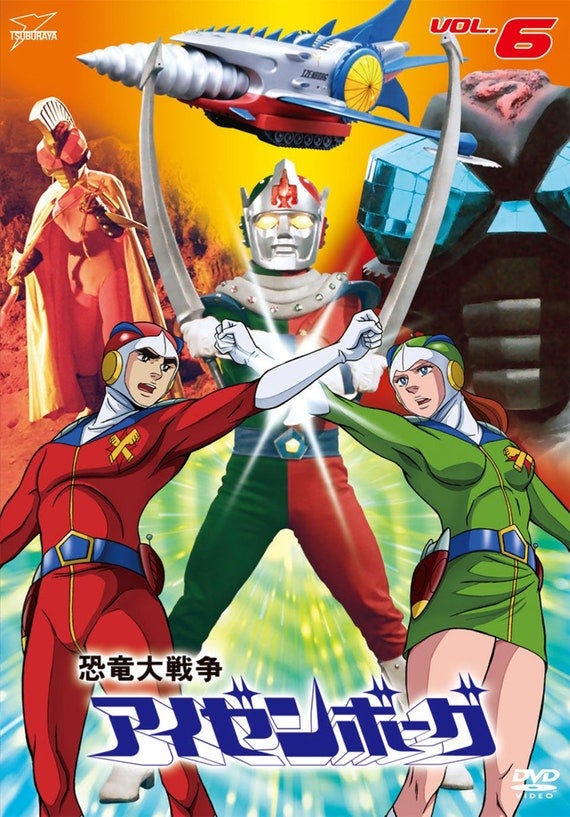
I could go on and on with more examples, but I’ll just give one more - Great Dinosaur War Izenborg (1976)2, which turns fifty next year. When brother and sister cyborgs Ai (‘Love’; right) and Zen (‘Good’; left)3 ‘Izencross’, their two vehicles fuse into a single flying super vehicle Izenborg (top), Zen becomes its pilot Izenborgman (center), and Ai becomes a circuit inside Izenborg.
![恐竜大戦争アイゼンボーグVOL.1 [DVD]](https://substackcdn.com/image/fetch/$s_!bdds!,f_auto,q_auto:good,fl_progressive:steep/https%3A%2F%2Fsubstack-post-media.s3.amazonaws.com%2Fpublic%2Fimages%2F3153fd2b-a5f9-49d1-8eb9-618191c80a38_700x1000.jpeg "恐竜大戦争アイゼンボーグVOL.1 [DVD]")
The siblings and their vessel can then fuse into a composite giant, Izenbo (center).
Meanwhile in the USSA, The Six Million Dollar Man (1973) and The Bionic Woman (1976) were hits.
Were, because the bionic boom went bust. Neither show lasted past 1978.
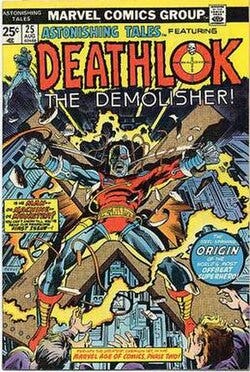
Marvel’s seventies cyborg heroes Deathlok (1974) and ROM (1979; one of my favorites) never achieved Spider-Man levels of fame.

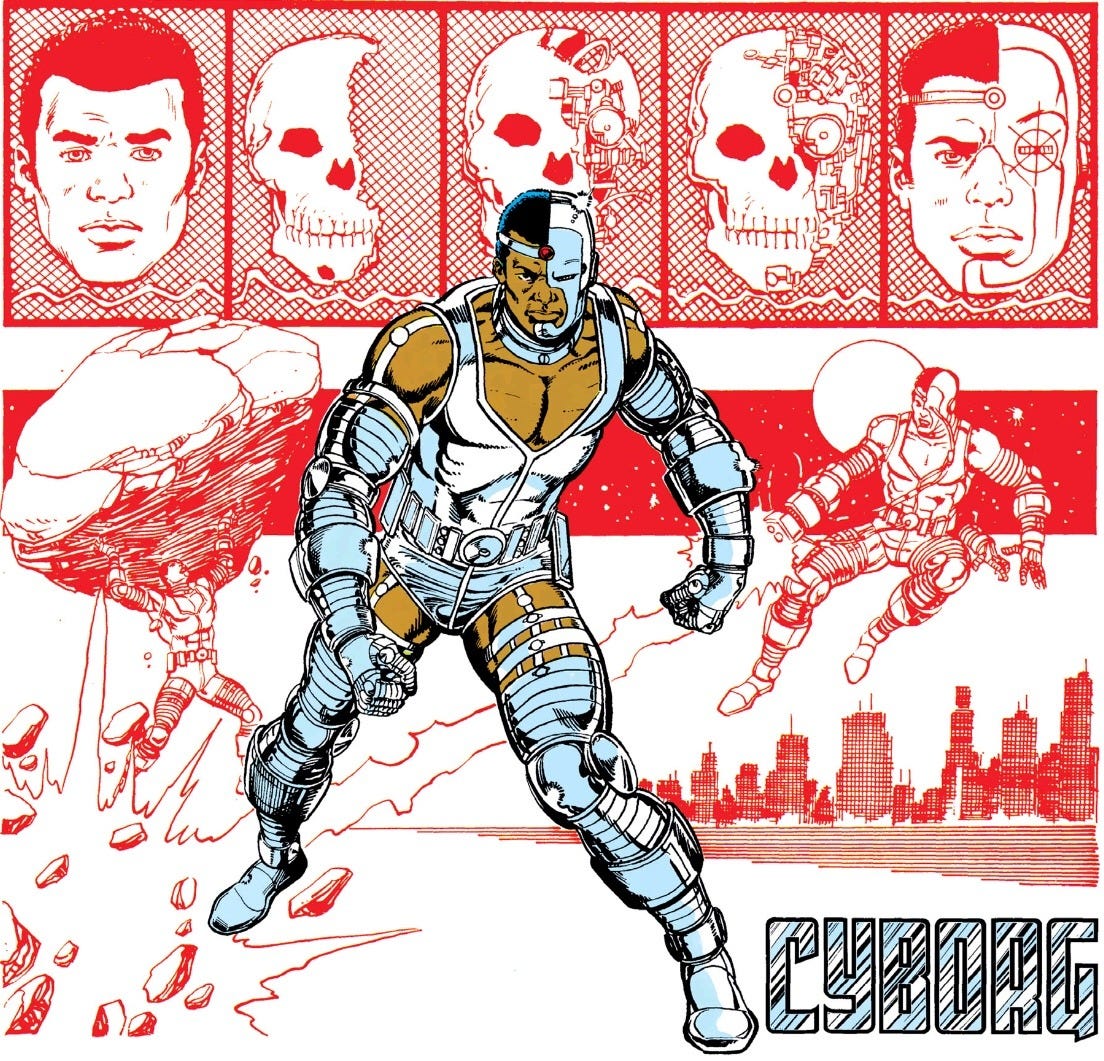
Similarly, DC Comics’ Cyborg never achieved solo success outside The New Teen Titans (1980).4
In 1991, I got the role-playing game Cyberpunk which prominently featured cyborgs.
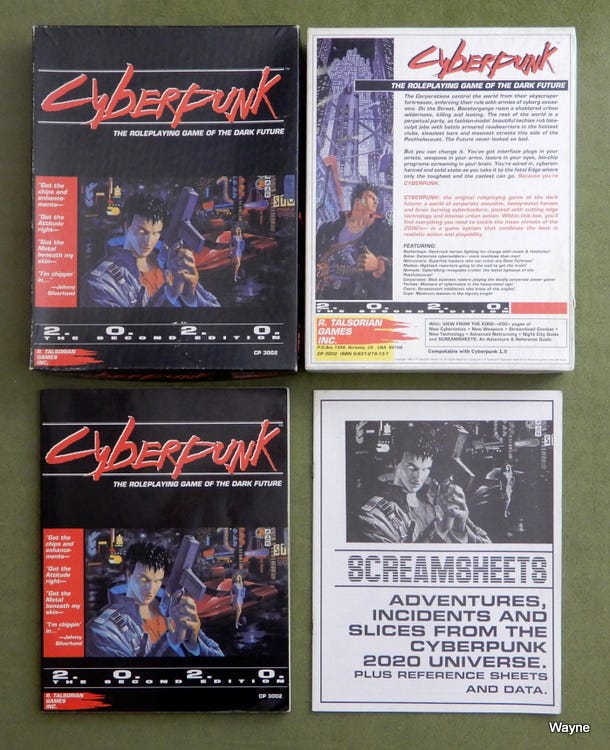
Cyberpunk didn’t become the next Dungeons & Dragons5, though it got a second life in 2017 as a video game (that just got a Mac version last July):
Based on Mike Pondsmith‘s Cyberpunk tabletop game series, the plot is set in the fictional metropolis of Night City, California, within the dystopian Cyberpunk universe. The player assumes the role of V (voiced by Gavin Drea or Cherami Leigh depending on the player’s choice of gender), a mercenary who gets reluctantly imbued with a cybernetic “bio-chip” containing an engram of legendary rockstar and terrorist Johnny Silverhand (voiced by Keanu Reeves). As Johnny’s consciousness begins overwriting V’s own, the two must work together to separate from each other and save V’s life.
Never played either version myself6, though I do know a player of the video game.
I leave you with a question I can’t answer: Why have cyborgs fallen out of favor in pop culture?7 We are closer than ever to creating real-life Six Millon Dollar men (and womyn and persyns). And the Regime wants transhumanism. Do they want it just for themselves? Are we peasants meant to get ersatz transhumanism, as in the scenario I just posted, or nothing at all?
Even if I had the time to watch it - no, I don’t even have six hours - I don’t have HBO. And even if I had HBO, I’d fall asleep unless I were doing something else while it played. And if I don’t pay full attention to a show, I can neither understand all the dialogue by ear (something I struggle with even with full attention) nor read all the closed captions. So I end up seeing shows multiple times to catch what I missed when sleeping and/or working, and that wastes even more time. That’s why I’d just rather not view any TV at all. Or movies - theaters are just expensive air-conditioned places to nap.
The first four episodes of Izenborg were dubbed in English and crudely pasted together into a ‘movie’, Attack of the Super Monsters (1983), that does not feature Izenbo, who doesn’t appear until episode 20.
The Izen- of Izenborg is a pun on the names of the siblings who form it - Ai ‘Love’ and Zen ‘Good’ - and German Eisen ‘iron’. 善 zen ‘good’ is homophonous with but unrelated to the 禪 Zen of Buddhism.
The RPG Shadowrun is a bit like a bridge between Cyberpunk and D&D
set in an alternate future in which cybernetics, magic and fantasy creatures co-exist.
It’s still around after thirty-six years, but it’s still not a household name either.
I couldn’t get into it. I only have a novel that I never read and a single sourcebook that I’ve only flipped through.
I used to collect RPGs without playing them. I used them as inspiration for the Bibles I was writing for my religion about myself.
Me-ssiah

In my last post, I said Nakayama Miki, the founder of the Japanese religion Tenrikyo, had chutzpah.
There are so many people on Substack that there must be someone else who also wanted to found their own religion. Nonetheless I’d be surprised if you read both their Stack and mine. I’ve only met one other person in real life who considered founding their own religion.
Maybe the assumption behind this question is wrong. Maybe there are prominent cyborgs in USSA and/or Japanese pop culture today. I wouldn’t know for sure because I completely gave up on anything current after being turned off by what I saw of the latest season of Rick and Morty. I just haven’t encountered any references to borgs in what little I hear about Breaking Bad, Game of Thrones, One Piece, Naruto, Attack on Titan, etc.
I just realized the anime adaptation of Ghost in the Shell (1989) is now thirty years old! Althogh there has been much more Ghost since then - the most recent example being a 2023 movie - the average Japanese person has never heard of Ghost, whereas they almost certainly have heard of Masked Rider in the same way that Americans who never read comic books know about Superman.
Surprisingly, Kotetsu Jeeg and Ghost in the Shell are the only two Japanese mecha anime titles I recognize.
"Do they want it just for themselves? Are we peasants meant to get ersatz transhumanism, as in the scenario I just posted, or nothing at all?"
I suspect you've already gleaned the answer. If They (I'm front-capitalizing because I don't know how to italicize text in comments) will expose any of us to their transhuman enhancements, it will only ever be experimentally, employing us as lab animals, to augment and induce and then to dissect the cadavers of the failures. This, like all technology, can't arrive fully-formed and optimized. If these technologies do indeed have real prospects of extending the range and powers beyond the human, They will not run the risk of losing Their express control of the technology. Transhumanism was only ever intended for Their benefit, never for ours. Were we to benefit, that would be disastrous for them.
A good gauge of what is happening was what occurred with the march of the Internet, which is a prerequisite for transhumanism: They had their Defense R&D Agency engineers devise and build the backbone (the TCP/IP protocol suite was officially adopted on January 1, 1983, and is widely considered the birth of the internet as a unified system though the origins of ARPANET are traced back to 1969, or even earlier). It was available first to universities and educational institutions, but the word and the use spread fast. Their myriad defense and civilian commercial subsidiaries were engaged in developing and distributing the network, recruiting scores of civilian engineers, and as the network spread more and more people gained access to it, increasing the traffic and the data generated, until we get to the present when it becomes clear that all that preceded this moment was according to a deliberate stratagem to connect everyone and everything, not in order to build community or any other wholesome-sounding tosh, but rather to confine onto digital plantations where we regular people can be rigorously surveilled and, importantly, farmed to generate vast amounts of data to feed Their data mining, machine learning, and Ai engines.(*) The Ai was envisaged, and is now ready to be deployed, as the great Eye In The Sky, God of the Earth and Heavens, governor, administrator, and executioner, and the robots are this god's hands and Greataxes. We mere mortal humans have become entirely superfluous - except in terms of the use we still have to them as experimental laboratory animals, as human models for the transhuman, the entirely engineered -- with all the inherent lapses, miscalculations, errors of judgement, and the hubris -- of an entirely human-contrived next step in evolution.
This is why they're bothering with the Digital ID program, even while we're already all but unnecessary: those of us they'll allow to continue to exist will require the enhanced connection to their data grid in order to be more effectively exploited as experiment platforms.
(*) 30 research articles were published just in the Journal Artificial Intelligence in Medicine (Elsevier BV) in the year 1993. Accordingly, just as they did with the Operation Warp Speed theatrical overture to the long-ready injections, they've been developing Ai for a long time, and when OpenAi's ChatGPT entered the stage, in reality, it was a long time in the making and waiting for the curtain call that was the COVID-19 operation in order to make its long-prepared entrance.
OMG!
KOTETSU JEEG!!!